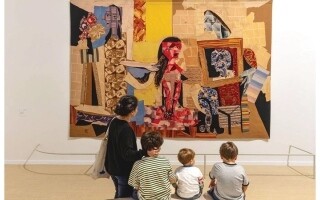
With over 130 artworks, the exhibition 'Picasso, Visions of the Form' opens at the Louvre Abu Dhabi, shedding light on one of the most influential artists of the 20th century. The exhibition traces Picasso's depiction of form, beginning with his early experiments in Cubism, moving through classical and Surrealist works, and culminating in the bold paintings he created in the later phase of his career. The exhibition, which runs until May 31, also features major works by six Arab artists, highlighting Picasso's influence on modern art in the Arab world and the resonance of this impact, which transcended European borders. The displayed collection includes paintings by Iraqi artists Dia al-Azzawi, Jawad Salim, and Shakir Hassan Al Said, as well as Egyptian artist Ramsis Younan. It also features a colorful ceramic work by Algerian artist Baya Mahieddine, whose 1947 exhibition at the 'Maeght' gallery in Paris attracted the attention of Surrealist artists and Picasso himself, reflecting a shared artistic exchange between them. The exhibition is divided into five thematic sections that connect the evolution of form in Picasso's work to mythical models. His early encounters with Catalan sculpture, as well as the arts of Africa and Oceania, shaped his unconventional simplifications in depicting form and the rise of Cubism. His return to Classicism after the war reveals his dialogue with the great masters through polished canvases and idealized forms. Meanwhile, the hybrid creatures in Surrealism, inspired by the myth of the Minotaur, reveal Picasso's passion for transformation and the underlying psychological tensions in his vision of form. Since the 1930s, the figures in his works have become more massive and prominent, reminiscent of prehistoric statues and the emotional weight resulting from conflicts. Among the notable works in the exhibition are the photographs of 'Dora Maar' documenting the creation of 'Guernica' and the Iraqi artist Dia al-Azzawi's 'Elegy for my Besieged City' (2011), which, when compared, show the similarities in their use of art as a tool for political commentary. The final section brings together Picasso's late works, distinguished by bold colors and liberated lines, with multiple perspectives, where figures of horsemen, wrestlers, and other models return him to his Spanish identity. The artworks in the exhibition are on loan from France, Qatar, Lebanon, the UAE, and West Asia, including seven works from the Louvre Abu Dhabi collection and six works from the Abu Dhabi Department of Culture and Tourism, along with other art pieces. The exhibition 'Picasso, Visions of the Form' is supervised by Cécile Debray, Director of the Musée National Picasso-Paris, Virginie Perdrisot-Cassan, Chief Curator and Head of the Sculpture and Ceramics Department at the Musée National Picasso-Paris, and Aisha Al Ahmadi, Assistant Exhibition Coordinator at the Louvre Abu Dhabi.. 6 Arab artists present their works at the exhibition.