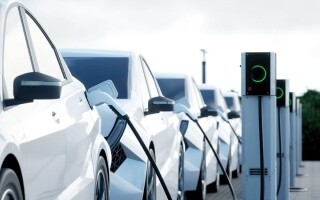
It should be noted that the communication standard (ISO 15118 20) regulates the exchange of information between the car and the charging station, such as charging time, state of charge, or power limits.
There are several ways to use bidirectional charging. In the "Vehicle to Home" (V2H) method, the electric vehicle directly powers the home's electrical grid, for example, when electricity demand increases in the evening and solar energy is not available. In combination with solar power systems (PV), homes can increase their self-consumption and reduce electricity costs. In this case, the electric vehicle essentially acts as a battery to store additional energy.
In the "Vehicle to Grid" (V2G) method, electricity from the electric vehicle is fed back into the electrical grid. This is a model for future energy markets, where thousands of vehicles can serve as temporary energy storage to smooth peak loads or prevent grid congestion.
In addition, there is the "Vehicle to Load" (V2L) method, where the electric vehicle acts as a power source to operate electrical appliances, for example, at construction sites, in campsites, or even during power outages. Many global companies offer this feature because it does not require any intervention in the grid or additional technologies, making it easy for any user to utilize.
Bidirectional charging offers great potential. It can help better integrate renewable energy sources into the electrical grid, support its stability, and rationalize energy consumption in homes. Electric vehicle owners can also reduce their energy consumption or even earn additional income through smart charging.
However, there are some limitations. Battery degradation due to frequent charging and discharging is a cause for concern, although global companies currently assume a lesser impact. Furthermore, appropriate tariffs, grid access, and digital control systems are needed to enable complex energy flows in daily use, but all these technologies are often very expensive.
This situation is likely to change significantly in the coming years, so people interested in buying a new electric vehicle should not give up on the bidirectional charging feature.
Most electric vehicles currently support bidirectional charging technology. The electric vehicle is no longer limited to just consuming electricity but can also feed it back into the grid.
As reported by the auto magazine "Auto Zeitung", an electric vehicle can be relied upon to charge electric bicycles, electric tools, outdoor sound systems, or even directly supply the electrical grid. This technology is known as "Vehicle-to-X (V2X)". This feature is not only practical but also a means of stabilizing the electrical grid and serves as an additional source of income for electric vehicle owners when supplying power to the grid (V2G).
The German magazine explains that in the traditional charging process, the electric vehicle's battery is charged from the grid, whereas in bidirectional charging, the process also occurs in the reverse direction through special converters, smart control units, and suitable charging infrastructure.
A basic requirement is that the car, the wallbox, and the home's electrical grid must technically support this function and be interconnected.
The technology required for bidirectional charging is already available in a small number of electric vehicles, but this number is increasing, and chargers and wallboxes equipped with bidirectional charging are also becoming available.