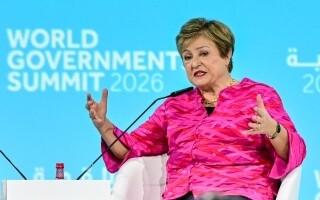
The Managing Director of the International Monetary Fund, Kristalina Georgieva, criticized the complexity of Europe's economic structure, considering that conflicting interests among member states and the lack of unified decision-making hinder the continent's ability to enhance its competitiveness in a rapidly changing world.
Georgieva said during a session at the World Government Summit that Europe comprises 27 countries, each with different interests. She pointed out that some countries oppose the creation of a true capital markets union because they prefer to maintain the dominance of banks, while others seek to protect their local labor markets, leading to the drawing of multiple 'red lines' that impede economic progress.
She affirmed that what Europe needs today is to remove these red lines and focus on its performance as a single economic union, explaining that the complexity of procedures and regulations continues to limit the continent's attractiveness for business and investment, despite a genuine desire from global companies to operate within the European market.
In a striking comparison, Georgieva viewed the European experience as carrying important lessons for the Arab Gulf region—not only in what should be done, but also in what should be avoided—while at the same time praising the transformations occurring in the Gulf Cooperation Council countries.
'I am very excited about what I see in the Gulf,' she said, referring to the growing interest in unifying systems, enhancing collective decision-making, and focusing on regional trade, confirming that the potential available to Gulf countries is 'huge.'
Georgieva offered direct advice to Gulf markets, warning against replicating the complex European institutional model and instead urged adopting one 'inspiring' idea: the experience of the company 'Airbus.'
She added that when Europe launched the 'Airbus' project, it succeeded in building a true global competitor to Boeing.
In this context, Georgieva saw that artificial intelligence could be the top candidate for such a joint project, noting that Gulf countries are already advanced in this field, and collaborative work in it could make a significant difference in the region's position on the global economic map.