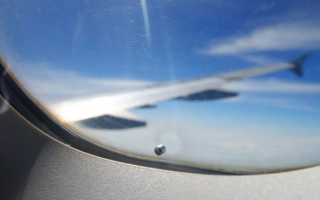
At altitudes of tens of thousands of meters, aircraft fly in harsh weather conditions, making every small detail in aircraft manufacturing subject to precise calculations. Near the base of the window, there is a small mysterious hole known as a ventilation or drain hole. It exists for a very good reason. When an aircraft flies at an altitude of 10,600 meters (35,000 feet) above the Earth's surface, the external air pressure drops to about 1.5 kilograms per square inch—a very low level that does not allow a person to remain conscious. To ensure passenger safety and prevent them from losing consciousness, the air pressure inside the cabin is artificially adjusted to about 3.6 kilograms per square inch. This creates physical pressure, and since high pressure is always drawn to low pressure, the air inside the cabin continuously pushes against its internal walls. As the windows are weaker than the metal structure, they are potential weak points where pressure can concentrate. Therefore, engineers designed them with a simple and distinctive technique. To address the pressure issue, the windows of most commercial aircraft are made of three layers of thick, durable industrial resin. Only the two outer layers are the structural layers designed to withstand extreme temperature changes and the large pressure difference between the passenger cabin and the outside world. The inner layer (which you can touch from your seat) is primarily intended to protect the other two layers from scratches, dirt, and impacts that passengers might cause. It is essentially a dust protective cover and is not airtight like the other two layers, allowing some air to pass around it. There is usually a small hole in the middle glass, its function is to allow cabin air to flow into the small gap between the middle and outer layers. This ensures that the main cabin pressure is concentrated on the outer glass, which is designed to be the strongest. In the event of damage to the outer glass—a rare occurrence—the middle glass remains strong enough to withstand the pressure. Additionally, the small hole helps regulate the temperature in the gap between the panes. When the aircraft climbs or descends, it is exposed to extreme temperature changes. If the air gap between the two panes were completely sealed, the expansion or contraction of the trapped air could cause additional pressure on the glass layers. By allowing small amounts of air to seep through the hole, the pressure inside the gap can be slightly adjusted with temperature changes, reducing the risk of cracking or distortion.