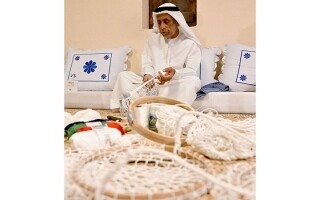
The sea has been a primary source of livelihood for the people of the United Arab Emirates for many years. Coastal communities were closely tied to the sea, and a significant part of their economy before the oil era depended on it, whether through fishing or pearl diving. Various industries were also linked to the sea, such as shipbuilding, fishing boats, and diving equipment, including the traditional craft of 'Diyain'. Despite the decline of pearl diving and extraction in the Gulf and worldwide, the UAE continues to strive to preserve this craft and introduce it to new generations. Father Ahmad Mohammad Al-Hammadi explained to 'Emirates Today' that the craft of 'Diyain' was once called 'Tarikat Al-Diyain'. It was taught by veterans of the pearling era who participated in the expeditions. These expeditions involved a large fleet of boats and ships, all following the instructions of the 'Sardal', the title given to the person who led the ships during the diving trip. He noted that the duration of these diving trips varied; some were short, lasting only a few days, while others, known as 'the big diving', lasted over four months. The boats, called 'Mahalim', were prepared with supplies consisting of 'Aish' (rice), dates, and fish they caught from the sea. He explained that diving would stop during the month of Ramadan, as it was difficult for divers to descend to deep depths while fasting. The 'Sardal' would give the order to return before the holy month began. He added: 'Diving was considered one of the most difficult professions practiced by our ancestors. During it, they faced numerous hardships, dangers, and various diseases. Over time, this profession declined. The day of return was called 'Al-Qafal'. Families would gather on the shore, 'Saf Al-Bahr', to welcome the boats and their crews with songs and cheers, awaiting the sustenance and gifts they brought'. He also pointed out that each 'Mahalim' carried between 100 and 120 people working in different professions, such as the 'Seeb' who stood on the ship, the 'Ghawwas' who dove to search for and collect pearls, and the 'Jallas' and 'Falak' who were responsible for opening oysters and extracting the pearls within them. Traditional crafts are a principal component of Emirati heritage, a testament to the skill of our ancestors and their ability to utilize the limited resources available in their environment to achieve the best use of them. With the establishment of the state, thanks to the era founded by the late Sheikh Zayed bin Sultan Al Nahyan, the conditions in society changed. Coinciding with the UAE's declaration of 2026 as the 'Year of the Family', we celebrate in this space the traditional crafts of the UAE and their practitioners who continue to work diligently and proudly to pass this heritage on to future generations, contributing to intergenerational communication and social cohesion.