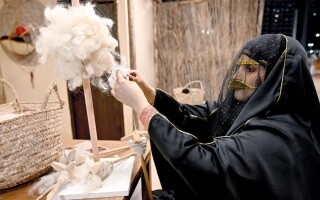
Traditional crafts are a main component of Emirati heritage, a testament to the skill of ancestors and their ability to utilize the few resources available in their environment to achieve the best possible benefit. The spindle is a wooden stick of a bent shape, around which natural wool is wound, and it has a hook in the middle to secure the wound wool. Another tool, called the "mgzala" or "tghazal", is also used; it is a piece of wood split in the middle, where the wool is hung during spinning. According to Muneera Zaid, spinning was used in Bedouin tents, for camel equipment, and for the pieces that were spread inside houses, such as the "rivag" that separates the men's area from the women's area. Women would gather to cooperate in spinning in an atmosphere of solidarity and cooperation, reflecting the bond that prevails in society. Muneera Zaid noted that spinning wool is a craft practiced by women, and they are keen to teach it to their daughters to continue preserving it. Spinning depends on the wool of livestock and camel hair, and is done using simple tools made by ancestors. They also used to use the wool and hair of these animals to make various products. Muneera Zaid, a wool spinning artisan, told "Al-Ittihad" that spinning wool is a traditional craft known to Emirati society for a long time. It was a craft practiced by women, and they were keen to teach it to their daughters to continue preserving it, as the products of spinning were very important in people's lives and indispensable. She added that spinning is no longer used to the same extent as it was in the past with the development and significant changes in life. She pointed out that spinning depends on the wool of livestock and camel hair, and is done through the use of simple tools made by ancestors. The spinning process includes several steps, starting with shearing and collecting the wool, then washing, cleaning, and drying it. Afterwards, the artisan fluffs the wool to facilitate spinning and to ensure there are no impurities. In the past, fluffing was done by hand, but over time, a tool was used—a wooden board with teeth called a "nfasha". In conjunction with the UAE's declaration of 2026 as the "Year of the Family", we celebrate in this space the traditional crafts of the UAE and their owners who still work diligently and proudly to pass on this heritage to future generations, contributing to intergenerational communication and bringing members of society closer together. The craft of spinning wool represents one of the most prominent manual crafts inherited from ancestors, especially in the desert environment. It is a craft that highlights how the population interacted with their surrounding environment and was able to utilize the few resources that nature provided them with, foremost among them the animals they were accustomed to raising, such as goats, sheep, and camels, which were a source of food, from which they obtained meat and milk, from which they made various products, the most prominent of which are cheese and butter.