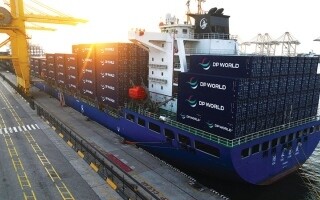
DP World invested in this project by providing 1,000 high-capacity 40-foot containers and 750 20-foot containers, along with an advanced digital platform that allows for full shipment tracking. The report highlights that the Sokhna logistics zone is distinguished by its strategic location near Sokhna Port and industrial and urban centers, offering integrated logistics solutions that include customs and non-customs zones, while providing real-time transparency in supply chains and accelerating customs procedures. This supports the efficiency of logistics operations, contributes to accelerating trade growth, generates job opportunities, and enhances economic development.
In Europe, DP World launched the marine service "Atlas" for transporting fresh products from Agadir, Morocco, to London Gateway and Antwerp Gateway, as part of strengthening sustainable trade corridors. The group also signed five memoranda of understanding and key agreements with the government and industrial sectors to build strategic partnerships expected to foster business opportunities and jobs within the infrastructure and maritime sectors.
In the Asia-Pacific region, the group invested approximately $100 million in Manila South Port in collaboration with "Asian Terminals Inc.," increasing the port's annual capacity to around 2 million TEUs, compared to the previous 1.45 million TEUs, an increase of about 25%. Development works included extending Pier 3 to over 600 meters, expanding yards to accommodate 20,000 containers, and adding two ship-to-shore (STS) cranes—massive container cranes used for loading and unloading containers. The introduction of eco-friendly equipment also contributed to these improvements, enabling the port to receive larger vessels and increase handling volume while improving the speed and efficiency of operations and enhancing safety levels.
In Syria, DP World officially commenced operations at Tartous Port in 2025 under a 30-year concession with planned investments of $800 million. The group's annual report indicates that starting operations in Syria represents a step aimed at modernizing one of the most strategically important ports in the Eastern Mediterranean. The modernization program includes developing infrastructure, implementing advanced digital systems, and adopting the highest standards of operation and safety, which will help reduce container processing times, enhance transparency, improve service reliability, restore Syria's commercial capacity, and support efforts for reconstruction and economic recovery.
In Egypt, the group launched the Sokhna logistics zone within the Suez Economic Zone, in partnership with the British Development Finance Institution, the UK's development arm. This move aims to enhance Egypt's trade links as a regional and global hub. The group invested $250 million in developing the port, improving operational efficiency and increasing capacity to handle over 90% of Tanzania's international trade. In 2025, the port achieved record growth, with container handling volume increasing by 55%. Economically, customs revenues reached $3.3 billion, an increase of $500 million, with annual savings estimated at $600 million due to reduced demurrage fees. Additionally, the cost per container decreased from $4,500 to $3,500, and 2,950 direct and indirect jobs were created, reinforcing East Africa's position as a growing logistics center.
In the Americas, the group approved $296 million in investments to expand its terminal at Santos Port, the largest port in Latin America, with the goal of increasing capacity by 25% to 2.1 million TEUs by 2028. This investment follows over 3 billion Brazilian reais the company has invested in Brazil since 2013, solidifying its position as one of the largest private investors in Brazilian ports. The expansion includes enabling the terminal to accommodate larger vessels, supporting growing export demand, and improving productivity through the construction of new berths, yard expansions, and the use of modern equipment, which will support Brazil's long-term commercial competitiveness.
In India, DP World announced its commitment to invest an additional $5 billion in India, in addition to the $3 billion already invested, to develop an integrated supply chain network. These investments focus on enhancing multimodal connectivity, supporting exports and local trade, and improving India's competitiveness in global trade.
DP World's annual report highlights the flexibility of its strategic plans across various operational scenarios. The company continued its global expansion strategy in 2025 through a series of investments and operational projects targeting port infrastructure development, trade flow enhancement, and supply chain efficiency, supporting the growth of international trade across multiple regions, including Africa, the Americas, Asia, Europe, and the Middle East. According to the report, the group handles around 10% of global container trade, while employing over 125,000 people across more than 80 countries through 664 business units.
This comes as Morocco exports over 1.1 million tons of fruits and vegetables annually to Western Europe, with annual growth projections exceeding 10%, making the service a direct response to increasing demand and reinforcing Morocco's position as a primary source of agricultural products.
The group's approach reflects DP World's strategy of large-scale investment, leveraging advanced technology, and utilizing its global network to develop infrastructure and enhance operational efficiency, enabling economies to access global markets, fostering trade growth, and boosting international supply chain resilience. The service aims to transport up to 150,000 tons of products annually from land to sea while reducing emissions. The group provides integrated services in ports, terminals, logistics, and maritime. The 2025 annual report highlights DP World's projects and investments in several markets, including Tanzania in sub-Saharan Africa, Brazil in Latin America, India in South Asia, the Philippines in Southeast Asia, as well as Syria, Egypt, and Morocco, linked to trade corridors with Europe.
In Africa, DP World began operating Berths 1 to 7 at Dar es Salaam Port in April 2024 under a 30-year concession, aiming to transform Tanzania's trade capabilities.