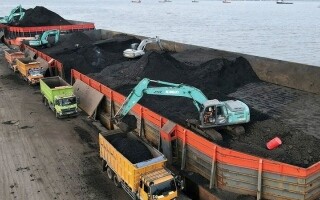
The halt in gas supplies is due to the closure of the Strait of Hormuz, through which passes one-fifth of global liquefied natural gas (LNG) shipments. Experts stated that strikes at key gas export facilities would exacerbate the shortage and impact the industry for many years. Henning Gloystein, Managing Director of Energy and Resources at the 'Eurasia' group, mentioned that nearly 30 billion cubic meters of LNG have been pulled from global supply chains, with over 80% of that missing in the Indian and Pacific Ocean region. He added that the last remaining shipments that passed through the strait before the conflict escalated will arrive next week. Gloystein explained: 'The global market has flipped from a very good supply surplus to a severe deficit in just four weeks. This will not only lead to sharp price increases but also a real fuel shortage.' He also noted that countries with coal reserves will use them as the fastest and cheapest way to replace LNG, though he pointed out that nations like India are also working to increase renewable energy use, accelerating licensing in Delhi for wind power stations and battery energy storage systems. According to Gloystein, restoring LNG supplies will take years. Transport workers went on strike last week to protest rising fuel prices. Bangladesh closed its universities early, leading to holiday schedule adjustments, and began implementing more planned power outages, while schools in Pakistan shifted to online learning. Other Asian countries have adopted stricter measures to conserve stockpiles. South Korea has urged households to shorten shower times, charge electronics during off-peak hours, and delay using high-energy-consuming appliances like washing machines until weekends. Meanwhile, Samsung restricted employee vehicle movement to ease the burden on energy resources. 'The Guardian' Pressure on Financial Resources The fuel crisis in Asian countries has placed significant pressure on government finances. For instance, Malaysia's monthly fuel subsidy bill rose from $174 million to over $797 million and could reach $6 billion if oil prices stay above $110 per barrel. Kuala Lumpur cut subsidized fuel allocations by a third before a weekend in an attempt to reduce costs. Climate experts warned about the environmental impact of coal, stating that the energy crisis should be a wake-up call for governments to invest in renewable energy sources. They emphasized that coal not only worsens climate risks but also contributes to pollution and air poisoning. They noted that the current energy crisis has confirmed the importance of renewables 'not just as a climate priority, but ultimately for broader energy security in Asia.' They added that economies with large amounts of renewable energy are actually less vulnerable. Henrich stressed that governments should not allow coal to become a permanent part of the long-term energy system. She stated: 'We must learn that this is the time to break the cycle of responding to short-term fossil fuel shocks with more fossil fuel investment, because it's never short-term; it's always some kind of long-term infrastructure investment.' In turn, Din Setiawati, lead Asia energy analyst at the Ember research center in Jakarta, said, 'reliance on coal is unsustainable,' noting that local renewable energy sources are certainly the best way to improve energy security and resilience. Reducing Consumption Asian countries are seeking ways to reduce energy consumption. The Philippines and Sri Lanka have implemented a four-day work week for many government employees, while Vietnam encourages its population to work from home. Thailand has introduced a four-day work week for civil servants and mandated raising office air conditioner temperatures to curb demand, while Vietnamese airlines have canceled some domestic flights as the country prepares for an aviation fuel shortage. Philippine President Ferdinand Marcos declared a national energy emergency last month, citing an 'imminent threat' to fuel supplies in the country. He said: 'This is not a short-term issue. People are hoping for some kind of lull, and then we go back to normal. This situation will last for some time because the damage will take years to repair.' Turning Point Meanwhile, climate and energy expert from King's College London, Pauline Henrich, stated that this crisis should be a turning point for governments. She confirmed that 'the impact of coal on the climate and health is devastating and catastrophic, and we've proven that over decades.' Governments across Asia are intensifying coal use—the most polluting fossil fuel—in an attempt to cover the massive and sudden energy deficit caused by the Iran conflict. This move has drawn warnings from climate experts who confirmed coal's devastating environmental impact, stating that the energy crisis should be a wake-up call for governments to invest in renewable energy sources, which can provide more stable supplies and are not subject to price shocks. Compensating for the Drop Across Asia, from Bangladesh to South Korea, governments are trying to compensate for reduced energy imports, most of which come from the Middle East. South Korea announced it will delay closing coal-fired power plants and lift restrictions on coal-fired electricity generation, while the Thai government increased output at the country's largest coal-fired power plant. The Philippines, which declared a 'national energy emergency' due to the war, also plans to boost coal power plant operations. In South Asia, India, which relies on coal for nearly 75% of its electricity generation, has ordered its coal plants to operate at full capacity and avoid planned outages, while Bangladesh increased coal-fired power generation and coal-fired power imports last March. Governments are scrambling to address the shortage, particularly in LNG supplies. Demand Doubled Many Asian countries depend on LNG for electricity generation and in industries like fertilizers. Demand in Asia is expected to double in the next 25 years.