Emirati designers shone at the 11th edition of Dubai Design Week, presenting designs and furniture inspired by local culture that reflect the nation's heritage, both in terms of traditional crafts and the use of materials representing the local environment. Many designers turned to materials native to the UAE, such as palm fronds, types of local wood, and date pits, which collectively present heritage in a contemporary format and steer towards sustainability in the design sector.
A Rich Heritage Emirati designs varied between chairs, chandeliers, tables, cabinets, and room dividers, all carrying contemporary forms derived from the rich heritage of Emirati culture. Studio 'One Third Studio' presented a table design, which designer Dana Al Ajlan spoke about, saying: 'I worked with designers Dana Al Ajlan and Amna Bin Bushar, and we chose to present a work titled 'Al Wasl,' which means connection, especially since Dubai has historically been a meeting point for trade and culture. We aimed to highlight this aspect through the design.' Al Ajlan added: 'The design is multi-functional; it can be a storage unit, a chair, or even a display for books or accessories. It is made from sustainable materials from the UAE's environment, such as natural wood and palm fronds applied using a marquetry technique with turmeric to highlight the color of the Emirati desert.' She noted that the design connects traditional and contemporary crafts, emphasizing that the shift towards sustainability is essential amidst the escalating environmental problems of our time. She confirmed that this is their second participation in Dubai Design Week, praising the Dubai Culture & Arts Authority's support for young designers.
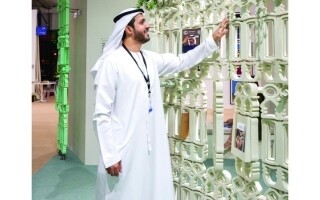
Old Houses Founder of 'Asateer' studio, designer Mohammed Al Suwaidi, presented a piece of furniture from the 'Warsh' collection, which is a 'room divider.' He pointed out that it is an architectural element found in old houses, and he intentionally reimagined it in a contemporary style to suit modern homes. Al Suwaidi noted that the design details are inspired by architectural elements from old houses, but the details are made movable, flexible, and rotatable. The gaps were filled with a set of accessories that add to the design's function, becoming hangers, shelves, photo frames, or even small planters. He mentioned that 'Asateer' studio always tells a story and a myth, adding a modern design while prioritizing the use of sustainable and local materials. He also added that he displayed a collection of tables in the pavilion for other designers, explaining that the manufacturing process aims to highlight craftsmanship. He expressed the importance of participating in the exhibition as it showcases the Emirati industry and helps build partnerships with design professionals and even the public.
Chandeliers and Tables In turn, designer Nasser Al Ghawi chose date pits to transform them into chandeliers and tables with an unfamiliar aesthetic. He highlighted that the chandelier is divided into nine cylinders, with each cylinder containing about 6,000 date pits. He explained that he carves the date pits to obtain a shape that allows him to use them in his designs. As for the chandelier, the date pits are affixed to acrylic and eco-friendly adhesive materials. He clarified that he obtains the pits from factories and reuses them. Al Ghawi also noted that while preparing for the table, new ideas emerged, leading him to design the table base from date pit carving waste, while the added threads were made from date pit threads and palm fronds. He stressed that as a designer, he seeks materials from nature to protect the environment, confirming that this is his first participation in Dubai Design Week. He joined the 'Tawasul' program organized by Tashkeel Center and received the opportunity to participate through it.
Cardamom Seed Also within the 'Tawasul' program, founder of 'Takseem' studio, Jasem Al Nakbi, presented a design called 'Haila,' inspired by a 'cardamom seed bracelet,' a type of Emirati gold. Al Nakbi pointed out that the piece that inspired the design had been passed down from his grandmother to his mother, and then to his sister, who will in turn pass it to her daughters. He mentioned a common saying in the UAE: 'Gold is an ornament and a treasure.' Therefore, he designed a jewelry box made of wood, metal, and red velvet fabric, where the external colors reflect the gradations of gold's color as it is passed down through generations. He confirmed that the metal used in the box is a sustainable metal, and he treated it to show golden and bronze colors. He explained that the box carries meanings from Emirati heritage, especially some details of the patterns used in traditional embroidery and much more. He expressed his happiness at participating in the exhibition, which spotlights Emirati designers and gives them the opportunity to present their creations to the public.
Diving Heritage Designer Amina Al Shamsi, along with designer Hanan Rifa'i, worked on a chair design that embodies the heritage of diving. Al Shamsi explained the chair's concept: 'In our studio, we work on designs that carry functions. We presented a chair titled 'The Diver,' an idea inspired by the world of diving in the UAE, especially considering that this field has changed significantly.' She noted that the design represents a state of waiting—the period that governed the diving process, when families would wait for divers to return from their trips, especially since some would return injured or not at all. She added that the design is made from recycled materials, while 3D printing was used to make it look like pearls. The chair also includes all the materials used to build boats. She believes that the orientation towards sustainability is crucial in design, especially given the limitations in the furniture production process in the UAE, which pushes recycling as a beneficial approach for society.