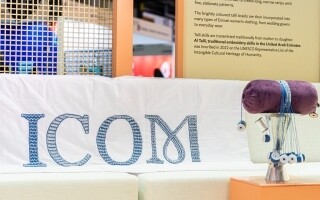
This initiative underscores Dubai's commitment to protecting traditional crafts and preserving living heritage, as well as celebrating its cultural value and enhancing its presence on the global map. The design features the ICOM logo in two shades of blue, woven using four traditional Tali stitches: 'Fanh al-Batikh', 'Brouwi/Mashara', 'Al-Fan', and 'Al-Qoli'. A group of national craftswomen from various emirates of the country participated in weaving the flag in accordance with the authentic traditions of the Tali craft, presenting a distinctive artistic work that embodies the aesthetics of local heritage and the precision of its inherited arts. This reflects the presence of Emirati crafts as an integral part of the country's cultural identity. This handicraft is distinguished by its fine metallic and silk threads, vibrant colors, and designs inspired by elements of the local environment, making it an original art form that reflects the identity and aesthetic tastes of Emirati society. Through the interplay and harmony of these stitches, an artistic tableau is formed, expressing unity in diversity by blending authenticity with innovation. It highlights the role of culture as a bridge for communication between peoples, a platform for envisioning the future, and a celebration of creativity rooted in Emirati heritage. It is worth noting that the UAE successfully inscribed the Tali craft on UNESCO's List of Intangible Cultural Heritage in 2022, a step that reflects the country's keenness to preserve this rich cultural asset, introduce it to the world, and highlight its precious value, in addition to emphasizing the importance of providing a suitable environment to ensure the sustainability of heritage industries. Tali is a traditional craft practiced by women within Emirati homes and is one of the most prominent components of local cultural heritage passed down through generations. Each stitch represents a artistic legacy that reflects the skill of the craftswomen and embodies the diversity of Emirati cultural fabric. These stitches complement each other to embody the conference's theme, 'The Future of Museums in Rapidly Changing Societies'. Tali remains a living craft today, studied and transmitted within families, schools, and cultural centers, maintaining its renewed presence as an art that brings generations together and embodies the spirit of creativity and Emirati identity. Three copies of the flag were produced. One was handed over to the Dutch city of Rotterdam, the second was deposited in the archives of the International Council of Museums (ICOM), while Dubai retained the third as the host city for the current session. The ICOM Dubai 2025 Organizing Committee handed over the ICOM flag to the city of Rotterdam, the Netherlands, which will host the 28th ICOM General Conference 'ICOM 2028', during the closing ceremony of the 27th ICOM General Conference 'ICOM Dubai 2025'. The conference is held under the generous patronage of His Highness Sheikh Mohammed bin Rashid Al Maktoum, Vice President of the State, Prime Minister, and Ruler of Dubai, and is hosted by Dubai for the first time in the Middle East, Africa, and South Asia region. The flag was distinguished by details inspired by embroidery and masterpieces of the traditional Tali craft, reflecting the spirit of local cultural identity, the country's connection to its intangible cultural heritage, and its approach to preserving and celebrating heritage as a source of pride for future generations. The implementation of the 'ICOM' flag project involved a series of meticulous and sequential stages, starting with the production of individual Tali strips, followed by the formation of the 'ICOM' logo and the meticulous attachment of its letters to the fabric, reflecting Emirati craftsmanship and artistic creativity.