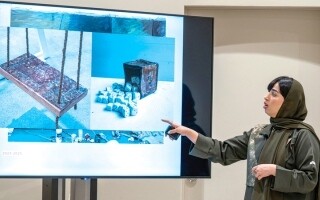
In the United Arab Emirates, young talents receive significant support and distinctive opportunities not only for success and presence on the stage but also to reach broader horizons by participating in regional and international events, becoming ambassadors for their country before an audience of diverse nationalities and part of the 'soft power' that defines UAE society, its local culture, history, and heritage, as well as future aspirations. One of the global events where Emirati participation was particularly distinguished was the recently concluded Expo 2025 in Osaka, Japan, where the UAE Pavilion became one of the most visited international pavilions, welcoming around five million visitors. The youth, serving as country ambassadors, were a creditable face and the main engine of the events and activities held at the pavilion. Many young people who participated in the Emirati pavilion at Expo 2025 in Osaka expressed to 'Emirates Today' their pride in being chosen as part of this historical event and representing the country before its visitors of various nationalities, introducing them to the culture of the UAE, its history, and modern achievements, as well as building cultural bridges with other cultures and exchanging experiences with them. Emirati artist Aisha Al-Ali spoke about her participation, stating that she conducted several workshops on cassette tape cover design, which is linked to her art project 'J-Emirati' that she began in 2021. She noted that through these artistic workshops, she focused on encouraging participants to discover the popular culture of the UAE, while also exploring their personal memories and experiences, prompting them to draw inspiration from their daily lives, their relationship with music or design, or anything that holds beautiful memories of the past, and to express that through a cassette cover design, on the condition that each design contains at least one element from the UAE's culture. Al-Ali expressed her happiness at the opportunity provided to her and the great support she received from the Abu Dhabi Department of Culture and Tourism, which chose her to participate in the exhibition and present this project to a large audience, which gave her the opportunity to explore how old designs can be blended with innovative modern ones to create a connection and dialogue between peoples and generations. Artist Asma Al-Rumayshi focused on manga, in which she specializes, by conducting a workshop on manga and graphic design as part of the 'Artists-in-Residence Program' organized by the Abu Dhabi Department of Culture and Tourism, aiming to create a fun and interactive way for Japanese participants to learn about the UAE's culture through art. She invited them to participate in 'Chibi doll cutting' inspired by Japanese manga and kawaii culture, with a focus on dressing the characters in traditional Emirati attire and learning the meanings and details of components of this clothing, from the shayla and thawb to the abaya, and from the kandura to the ghutra and egal, which formed a creative bridge between the two cultures, as it relied on a familiar Japanese artistic style to tell Emirati stories in a contemporary and easy-to-understand manner. Asma said: 'I was amazed by the interaction of Japanese participants of all ages, from young children to elderly women, and their clear enthusiasm. There were entire families, from children to grandparents, participating in the activity as one team. What attracted my attention the most was their constant curiosity; they kept asking questions about the details of Emirati clothing, such as the burqa and abaya to (the ghutra) and (the egal), to understand the symbolic meanings behind each element. Some requested to take pictures with me next to their works done in the workshop, to highlight how they bridged the two cultures through one artistic medium. Those moments embodied a genuine cultural exchange, conscious interest, mutual respect, and shared joy through creativity'. Participation in the Emirati pavilion at Expo 2025 in Osaka was not limited to visual arts and culture. The participation of Sarah Abu Fraheh and Khaled Shalha was centered on the field of sustainable construction, in which they specialize, by designing a workshop as a practical and cultural introduction to alternatives to traditional cement and concrete, and introducing the 'Dikreet' material—an alternative free of cement and resin, made from ground palm pits, which is in the process of obtaining a patent. The workshop also included discussions on the world heritage of cementitious materials, from Middle Eastern plaster to Japanese Shikkui lime plaster. Khaled Shalha said: 'For us, sustainability represents a responsibility towards our material choices, as the largest part of the carbon footprint of any product or piece is determined at the design stage, which places a duty on designers and artists to make a conscious choice of materials. In our case, Dikreet was born not only from a scientific innovation but from a critical cultural and environmental stance against extraction systems. It brings together two sectors that rarely intersect, construction on one hand, and food and agriculture on the other, in an integration that produces a material with meaning and makes sustainable design tangible and visually and emotionally perceived'. Sarah Abu Fraheh said: 'Through art and design, sustainability becomes less linked to concepts of compliance and carbon credits and more connected to storytelling, building connections, and long-term thinking'.