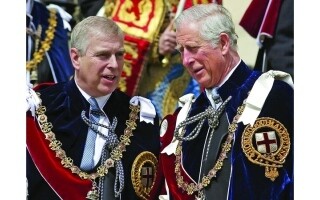
King Charles III is acting swiftly, as members of the Windsor family always do, and rather harshly in dealing with his scandal-plagued brother. The King has stripped Andrew of his 'Royal Highness' title and announced he will be evicted from his Windsor residence soon. Minor details, such as Andrew having a strict lease on Royal Lodge, or being born a prince as the son of Queen Elizabeth II, proved to be troublesome. After days of painful headlines, the King's brother will now be known as Andrew Mountbatten-Windsor and will soon leave Royal Lodge. The matter was settled decisively, according to the royal press release. Royal historian Ed Owens said: 'Charles is acting out of a sense of duty to protect the monarchy and its reputation by sacrificing his brother.' He added that the monarchy could have 'spared itself a lot of trouble' if these measures had been taken after Andrew's infamous BBC interview in 2019.
Prince Harry and Meghan When Prince Harry and Meghan, who complained about being harassed by the tabloid press, proposed a new practical arrangement, Queen Elizabeth II gave it only a passing glance. She clarified that they could not be 'half in, half out', living abroad part-time while continuing to perform their official duties and maintaining their security protection. Owens noted that in this case, perhaps Elizabeth herself was more open to a settlement, but the courtiers were not. 'The institution is run by cold-blooded individuals who do not get drawn into emotional wars,' he said.
Princess Margaret In the 1950s, Britain was captivated by the love story between Princess Margaret and Captain Peter Townsend. Townsend, a handsome officer serving in the royal household, fell in love with the younger sister of Queen Elizabeth, who was charming and vivacious, and wanted to marry her. But Townsend was divorced, which was a 'dangerous' problem under the rules of the Church of England, of which Elizabeth was the head. The Queen asked her sister to wait for a year, and the officer was sent to Brussels. Owens noted that while it is not known exactly what passed between the sisters, it is believed the Queen explained to Margaret that if she married Townsend, she would have to relinquish her royal duties and privileges.
King Edward VIII This was not the case in the previous generation. King Edward VIII's abdication remains the ultimate royal sacrifice. Less than a year after ascending the throne, Edward VIII chose love over the monarchy, or perhaps the monarchy chose the throne over him. The government and the Church, which at the time opposed remarriage after divorce, thwarted his desire to marry American divorcée Wallis Simpson. In his address to the nation, he said: 'I have found it impossible to carry the heavy burden of responsibility and to discharge my duties as king as I would wish to do without the help and support of the woman I love.'
King George V During World War I, the royal family's ties to Germany came under scrutiny, and this was not the first time. King George V ruled Britain during the global conflict, and his role as a wartime king required patriotism and pragmatism. In 1917, amid rising anti-German sentiment, he changed the royal family's name from 'Saxe-Coburg and Gotha' to the thoroughly British 'Windsor' and stripped his German relatives of their British titles. He also refused asylum to his cousin, the deposed Tsar Nicholas II, his wartime ally, for fear that sheltering a deposed tsar could fuel domestic social unrest.