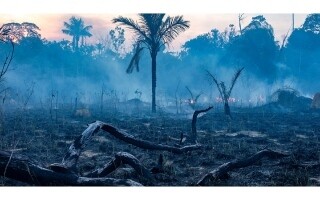
A study published in the journal 'Scientific Reports' by a team of researchers from the National Centre for Earth Observation at the universities of Leicester and Sheffield in the United Kingdom has revealed that African forests have shifted from being a carbon sink to a carbon source. The research focuses on the urgent need to act swiftly to save the world's great natural climate regulators. This terrifying shift, which occurred since 2010, indicates that all three major forest regions on Earth—the Amazon in South America, the forests of Southeast Asia, and Africa—have changed from being 'allies' in the fight against climate change to becoming part of the problem. They are no longer performing their role of absorbing carbon from the air, as occurs through specific processes in the green leaves of these forest plants. 'Human activities' are the primary cause of the problem, as farmers cut down more trees and remove all wild plants from forest areas to cultivate crops for food production. Infrastructure projects, mining, and wildfires have exacerbated the loss of the Earth's vegetation, increasing global temperatures already caused by burning gas, oil, and coal, and thus destroying the resilience of the ecosystem. Scientists discovered that between 2010 and 2017, African forests lost about 106 billion kilograms of biomass annually, equivalent to the weight of approximately 106 million cars. The most affected were the moist, broadleaf tropical forests in the Democratic Republic of the Congo, Madagascar, and parts of West Africa. Using satellite information and machine learning, the researchers were able to monitor nearly a decade of changes in the amounts of carbon stored in trees and woody plants. The researchers found that African forests gained carbon between 2007 and 2010, but since then, widespread forest loss has disrupted the balance, causing the continent to contribute more carbon dioxide to the atmosphere instead of absorbing it, as is known to be the role of green plants in these forests, which is to absorb carbon and release oxygen into the air. The study's authors stated: 'The results show the urgent need to take action to stop forest loss, otherwise the world risks losing one of its most important natural carbon sinks.' They point to Brazil's initiative, the 'Enduring Amazon Fund', which aims to raise around $100 billion to protect forests from being cleared for crops by providing financial aid to the countries overseeing these forests to stop clearing them and converting them into farmland. However, so far, only a few countries have donated money, with only about $6.5 billion raised for this initiative. The lead researcher, Professor Heiko Balzter, director of the University of Leicester's Institute for Future Environmental Futures, said: 'This study shows how crucial it is to scale up the Enduring Amazon Fund quickly before it's too late, especially as the Earth is suffering from environmental problems, some of which are reaching the level of destruction and loss of life.' He added: 'Policymakers want to respond to deforestation by providing better guarantees for the world's tropical forests.' 'At the COP26 conference in Glasgow, world leaders announced their intention to end global deforestation by 2030, but progress is not being made at the speed hoped for by scientists and researchers,' he continued. The new forest fund aims to pay forest-rich countries to keep their tree roots in the ground, a way for governments and private investors to counter the drivers of deforestation, such as mining for minerals and exploiting land for agriculture, but countries need to contribute more to make it a success.