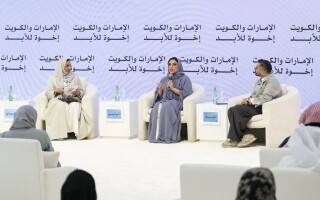
During the 'Emirati-Kuwaiti Song' session, the history of musical cooperation between the UAE and Kuwait was reviewed, along with the milestones at which joint songs became a cultural and emotional symbol for the peoples of the Gulf. This was discussed at the Emirati-Kuwaiti Media Forum, held today at the Museum of the Future in Dubai, as part of the 'UAE and Kuwait: Brothers Forever' week, running from January 29 to February 4 across all emirates of the country. The session featured composer and songwriter Khaled Nasser, Chairman of the Board of Directors of the Kuwaiti Artists Association Anwar Abdullah, and composer Ibrahim Juma, Arts Advisor at the Hamdan bin Mohammed Centre for Heritage. The session was moderated by Asem Al Naqbi. Anwar Abdullah confirmed that his artistic career included fruitful collaboration with several Emirati artists from the beginning of their careers, such as Hussein Al Jasmi and Faisal Al Saied, noting that his experience with Emirati artists began in 1985 and continues to this day. He added that joint songs with Kuwaiti artists strengthened the bonds of love between the two peoples, emphasizing that the UAE and Kuwait represent one people. He expressed his pride and honor in having composed poetry for the late Sheikh Zayed bin Sultan Al Nahyan, God rest his soul, and for His Highness Sheikh Mohammed bin Zayed Al Nahyan, President of the country, God protect him, as well as for His Highness Sheikh Mohammed bin Rashid Al Maktoum, Vice President of the country, Prime Minister, Ruler of Dubai, God protect him. He stressed that the blend of beautiful Emirati words and Kuwaiti melody gave the songs a special artistic dimension and contributed to their acceptance by the public, forming a distinguished artistic bridge between the two countries. Meanwhile, Ibrahim Juma said, 'Our relationship with the sisterly State of Kuwait began in our infancy, as we studied according to the Kuwaiti curriculum, which had a great impact on fostering our love for Kuwait and its people.' He added that Kuwait in the 1960s and 1970s was a cultural and artistic beacon for Emirati composers and singers, as well as for Gulf countries. He pointed out that the establishment of 'Emirati Arts' studio by Kuwaiti composer Anwar Abdullah significantly contributed to the development of the Emirati song. Juma confirmed that the cooperation between Emirati and Kuwaiti artists is based on the spirit of brotherhood, away from material calculations, noting that Kuwait was a launchpad for composers seeking fame. Khaled Nasser, for his part, said that collaborating with pioneers of Kuwaiti singing was a very important experience that contributed to merging Emirati and Kuwaiti art and produced musical works that were well-received by the public and achieved wide spread. He noted that Kuwaiti artists influenced Emirati artists in terms of style, musical language, and artistic culture, describing the 'Emirati Arts' studio as a university that brought together Emirati artists and blended Emirati singing with Kuwaiti rhythm. The 'Voice of Youth and Digital Media: Enhancing Emirati-Kuwaiti Relations through Content' session highlighted the growing role of digital content in strengthening bridges of communication and cementing fraternal relations between the UAE and the sisterly State of Kuwait, confirming that modern platforms have become an effective space for creating awareness and conveying values and messages that reflect the depth of the historical ties between the two brotherly peoples. This was part of the Emirati-Kuwaiti Media Forum, held today at the Museum of the Future in Dubai, as part of the 'UAE and Kuwait: Brothers Forever' week, running from January 29 to February 4 across all emirates of the country. The session featured Kuwaiti media figure Ali Najem and Emirati media personality Mona Al Raeesi, and was moderated by journalist Hajar Al Khouri, where the profound changes brought by the digital media sector to the concept of media influence were reviewed, along with the leading Emirati and Kuwaiti experiences in this field. Ali Najem confirmed that today's Gulf youth possess an influential voice on social media, through which they express their culture, identity, history, and present, noting that this influence has transcended his country and the Gulf countries to reach the wider Arab world. He added that the voices of the Gulf on digital platforms are characterized by creativity and a positive spirit, considering that what is striking is the unity of Gulf youth in presenting a bright image of their societies through constructive and purposeful content. Najem expressed his admiration for several Emirati media programs for their meaningful message, professional presentation style, and handling of issues, confirming their role in enhancing community awareness and shaping a positive image of the country. Speaking about traditional media in the era of digital media, Najem explained that new media have brought greater spontaneity and simplicity in addressing various issues, confirming that the audience is drawn to quality content and interacts with it, regardless of the medium or platform through which it is presented. Meanwhile, Mona Al Raeesi stated that media relations between the UAE and Kuwait date back to the pre-Union era, noting that Kuwait played a pivotal role in supporting the Emirati media sector by providing technical and training expertise and supporting Emirati cadres in the initial stages. Al Raeesi emphasized the high level of Emirati and Kuwaiti content, insisting that serious content imposes itself on the public and is one of the tools of soft power for the state in various fields. She pointed out that many Emirati media leaders received their media education in Kuwait and worked in the media sector there, which contributed to strengthening professional and creative ties between the two sides. She noted that today's media sector is no longer limited to producing news and content but has become a real driver of the national economy and a key partner in the development process, confirming that the UAE played a leading role in developing the modern media landscape and were the first in the Gulf and Arab world to establish media free zones. Al Raeesi concluded by emphasizing that the role of a media person is no longer limited to reporting the news but has become a key actor in conveying the state's narrative and building its mental image, considering that media people today represent one of the most important tools of soft power.