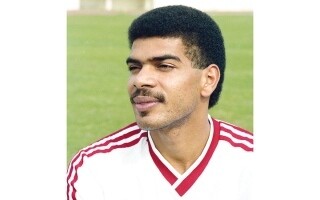
Former UAE national team and Al-Nasr player Khalid Ismail has denied rumors that have circulated for years about him receiving a Rolls-Royce car as a reward for scoring the UAE's goal in the 1990 World Cup finals. He stated that this account is "completely untrue," despite its long circulation.
In an interview with "Al Ittihad" as part of the "Ramadan with Al Ittihad" segment, Khalid Ismail said he never received any material reward from any entity or individual. He added that the only reward he received was a financial one from His Highness Sheikh Hamdan bin Zayed Al Nahyan, the Ruler's Representative in the Western Region (and President of the Football Association from 1984 to 1993).
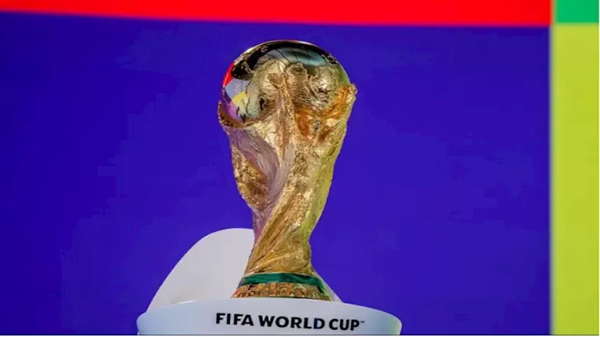
Khalid Ismail confirmed that the goal he scored against Germany during the UAE's participation in the 1990 World Cup will remain the most precious of his football career, not only for its technical value but also for the national symbolism it carries.
He said: "The goal's importance stems from being the first for the UAE in a World Cup and the country's first participation in this global event. Its value is tied to the name of the UAE more than to my personal name, as I was representing the nation on the biggest football stage, a dream every player has, and how much more so when that debut is marked by scoring a goal."
He added: "The goal's significance was amplified by the fact that it came against a team that would later go on to win the tournament, which gave it wide fame afterward." At the same time, he emphasized that he "did not treat it as a personal achievement as much as an achievement for UAE football."
He revealed that the "real gain" he took from the World Cup was the boots he scored the goal in, explaining that he had intended to discard them after they tore on both sides, were it not for the advice of former international referee Ali Bujsim, who advised him to keep them.
He added that the boots were later sold for 700,000 dirhams for the benefit of "Dubai Cares."
Khalid Ismail recalled the 1990 World Cup qualifiers, noting that the team faced complex circumstances before and during the qualifiers. The players were surprised during their training camp in Spain by the news of the resignation of the Football Association's board, then headed by His Highness Sheikh Hamdan bin Zayed Al Nahyan, at a time when there was insufficient financial support or stable administrative presence.
He added: "The fans were not pressuring for specific results, but the players united in the dressing room around the goal of qualifying, and they managed to achieve it, making the team the first Emirati team to reach the World Cup in their second attempt at the qualifiers."
Khalid Ismail stressed that the financial aspect was not dominant for football players in the 80s and 90s of the last century, confirming that he used to receive a monthly salary from Al-Nasr club of 1,500 dirhams.
He said: "Al-Nasr club built a strong generation, and it was the only club in the state that gave its players a monthly salary equally to all players of the first football team in the club, amounting to 1,500 dirhams, and there was no distinction between a player and another. Even with the national team, we did not get a salary from the Football Association, and all we used to receive was daily pocket money, its value was only 370 dirhams, and I remember that the highest bonus we got was in the 1990 World Cup qualifiers in Singapore, where each player received 10,000 dirhams."
Broken ties with Al-Nasr
Khalid Ismail confirmed that his relationship with Al-Nasr club has been broken for more than nine years, and during that time he had visited the club only once, to attend a match in the UAE-Qatar Super Cup, by invitation from Al-Nasr's figurehead Matar Al-Tayer.
He recounted that he faced a difficult situation when he was prevented from entering the club on the pretext of not carrying a ticket or an official invitation, before some figures from the club intervened to resolve the issue and convince him to stay.
He added that his love for Al-Nasr has not changed, expressing his hope to see the team competing for titles, but he felt that there are those who do not want him to hold an administrative position in the club because of his repeated criticisms of the wrong situation. He pointed out that he faced a lawsuit over press statements, and the case lasted for about a year and a half before it ended with him paying a fine of 20,000 dirhams without any administrative intervention to resolve it amicably.
He believed that Al-Nasr's crisis, which has spanned four decades without achieving a league title, is due to repeated administrative changes and the lack of stability. He confirmed that the problem is not in the capabilities, but in the lack of clarity of vision and long-term planning both on and off the field.
Beginning at Al-Wasl
Khalid Ismail revealed that he started his sports career in the ranks of Al-Wasl club as a volleyball player before moving to Al-Nasr to play football on the advice of his older brother Saeed Ismail and a number of their friends, where he built his football career.
He explained that "the real Dubai derby" in the 80s and even until the late 90s was between Al-Nasr and Al-Ahli, before later attention shifted to the matches between Al-Nasr and Al-Wasl in Bur Dubai.
The Lost Qualification
Khalid Ismail expressed his regret that some opportunities that presented themselves to the team to qualify for the 2026 World Cup were not exploited.
He said: "The team had an easy opportunity to qualify for the World Cup, but unfortunately, the Portuguese coach Paulo Bento squandered it, whom I consider the worst to have ever coached 'Al-Abyad' in history. The circumstances were very easy, and when the mistake was corrected, it was too late, with the contracting of the Romanian coach Ilario Cosmin. I believe that if he had been contracted earlier, our national team would have qualified for the World Cup."
Professionalism
Khalid Ismail said that if he were in charge of Emirati football, he would have decided to cancel the professionalism system after the failure to reach the World Cup. He explained that the decisions supporting the national team, including professionalism, naturalization, and great financial support, did not yield the desired goal.
He added: "Returning to the amateur system might be an option in light of previously achieved achievements. I am not against the system of the resident player in principle, but its implementation was not according to the specified controls, which negatively reflected on the opportunities of the national player."
Ramadan Atmosphere.. and the memory of "Umm Mahmoud"
On a humanitarian level, Khalid Ismail spoke with sadness about his longing for his wife "Umm Mahmoud," who passed away eight years ago, noting that the Iftar table is no longer as it used to be.
He said that he and his children remember her with the advent of the month of Ramadan and recall the various dishes she used to prepare. He added that the atmosphere of the month in his childhood was different; it was filled with Ramadan events and fireworks that often caused "hair burning," scenes that are still etched in his memory.