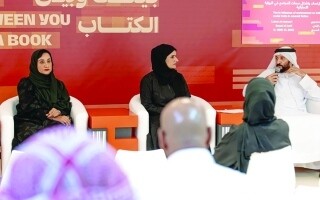
During a discussion titled «The Impact of Place on Humanity and the Shaping of Society's Traits in the Emirati Novel», as part of the 44th Sharjah International Book Fair, writers and novelists explored the role of place in literary works. They agreed that in literature, place is not merely a geographical backdrop for events but a central element that shapes identity and characters, and a symbolic space reflecting societal and cultural transformations. Emirati writer Lulwa Al Mansouri noted that Emirati society, despite its traditional past, was rich in knowledge, crafts, and industries, serving as a source of inspiration for contemporary prose. «We strive to reproduce and interpret what has been narrated but not documented, working to revive the past to preserve the memory of the Emirati place,» she said. «I call this process a 'productive nostalgia' — a nostalgia that transforms into text and creativity to keep the past alive in the memory of modern works». Emirati writer and novelist Saeed Al Badi added that place in the Emirati novel is influenced by environmental elements like the desert, sea, travel, and winter. «The desert symbolizes both freedom and being lost, while the sea reflects adventure and the quest for a livelihood,» he explained. «In contrast, urban life reflects a sense of alienation». He emphasized that the roots of Emirati society lie in villages, not cities, which is why components of nature and the environment are found in the language, narrative, and vocabulary of the writer. «Place plays a role in shaping the writer's identity and is inevitably reflected in their writings, whether they are from a village or a city,» Al Badi concluded.