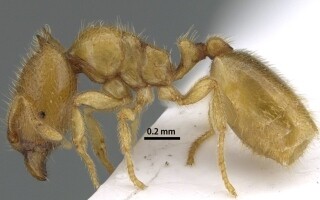
The Environment and Natural Reserves Authority in Sharjah, through the Al-Zid Center for Wildlife, announced the discovery of a new and rare species of ant in Wadi Shais, officially documented as Carebara Sharjahensis and known as the 'Sharjah ant'. This discovery adds to the emirate's achievements in scientific research and biodiversity conservation. It is the first discovery of the Carebara genus in the UAE and the third on the Arabian Peninsula, highlighting the richness of the Hajjar Mountains with endemic and rare species. The discovery was made by Dr. Mustafa Sharaf from the Al-Zid Center for Wildlife after conducting detailed field surveys in Wadi Shais, where a single soldier caste specimen was found despite multiple visits to the site. This indicates that this species inhabits highly specialized environments and tends to lead a subterranean lifestyle, which makes it difficult to detect. The Authority stated that the discovery of the 'Sharjah ant' represents a scientific achievement that enhances the emirate's efforts in supporting specialized research and documenting the environmental wealth of the Hajjar Mountains, praising the role of the Al-Zid Center for Wildlife team and their continuous efforts in conducting field research and environmental surveys. It also clarified that this rare discovery reflects the success of the environmental monitoring system in Sharjah and the efficiency of its specialists, embodying the emirate's vision of establishing science and knowledge as the foundation for conserving and sustaining biodiversity. The scientific study revealed that the 'Sharjah ant' is distinguished by unique anatomical features, the most prominent of which are the developed lateral horns on the head, interspersed with fine hairs, a uniform yellow color, and detailed structural features in the head and thorax, making it a significant addition to the region's biological inventory. Researchers continue to conduct field surveys to discover more colony members, as initial indicators suggest that this species follows a subterranean lifestyle and relies on living in soil and decomposed organic matter.