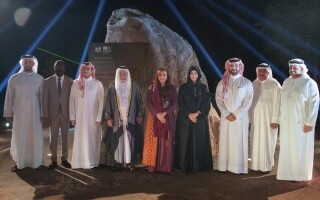
His Highness Sheikh Dr. Sultan bin Muhammad Al Qasimi, Member of the Supreme Council and Ruler of Sharjah, highlighted the exceptional nature of the archaeological site 'Al-Fayha', which stores not only layers of time in its rocks, but also stories about the first presence of humanity on this earth. His Highness said in his speech at the official ceremony to announce the inclusion of 'Al-Fayha' in the UNESCO World Heritage List: 'We stand here before living pages of the book of humanity, a book that tells us how man lived, how he faced his environment, how he turned challenges into knowledge, patience, building and wisdom, how he made experience his way of life, and how he made experience a consciousness that accumulates from generation to generation.' The ceremony was also attended by Sheikh Sultan bin Ahmad Al Qasimi, Deputy Ruler of Sharjah; Sheikha Latifa bint Mohammed bin Rashid Al Maktoum, Chairperson of the Dubai Culture and Arts Authority; and Sheikha Bodour bint Sultan Al Qasimi, Ambassador of Al-Fayha for World Heritage. His Highness the Ruler of Sharjah also touched upon the value of historical sites, saying: 'The true value of historical sites is not material, but primarily cultural and human, a value that gives man the ability to understand his long journey on this earth, and connects the present with its first roots, so that the future does not become separate from its memory or roots. Every heritage site is an open school for generations.' He added: 'When we give these sites the study and protection they deserve, we are not preserving just a stone or a trace, but accumulated knowledge, an enduring human experience, and we help generations build a deeper understanding of their identity and their role in the present and future. Because what we preserve today protects our identity tomorrow.' His Highness also mentioned the efforts of researchers working on excavations: 'Among what Al-Fayha reveals is a plan that changed the world's understanding of the human journey. When modern excavations began, researchers did not expect that Al-Fayha would break one of the oldest scientific assumptions about human migration, but the earth spoke its word, and the earth does not lie when it speaks with science. Precisely crafted stone tools appeared, and after analysis, it turned out that their age exceeds 200,000 years. At that moment, scientists realized they were standing before a historical testimony stating that modern man was here, on this earth, much earlier than was believed.' His Highness the Ruler of Sharjah added: 'Al-Fayha has provided a new and documented map of human migration and its routes, proving that the Arabian Peninsula was not just a transit corridor, but an early home in humanity's journey from Africa to the world, and a place of settlement and life. Thus, Al-Fayha is no longer a local place in the memory of the place, but a central station in the memory of all humanity. From here, we do not view the inclusion of Al-Fayha in the UNESCO list as an acknowledgment of the history of this region, because history affirms itself by itself, and we have no merit in it, but there are many duties upon us, foremost among them being fidelity and preservation. We view this inclusion as a new gift that this region offers to humanity, just as it has offered it throughout its history the first agriculture, the first trade, the first road networks, the first administrative systems, the earliest civil and social structures. With this inclusion, humanity now has a new window to look into the past of this region, to learn and draw from the experiences of those who came before us.' His Highness concluded his speech by thanking Sheikha Bodour bint Sultan Al Qasimi for her great efforts in leading this file, and appreciating the role of the Sharjah Authority for Antiquities and all partners, researchers and specialists who contributed to achieving this achievement. The ceremony, held at the Mleiha Archaeological Center, began with His Highness the Ruler of Sharjah unveiling the commemorative plaque for the inclusion of Al-Fayha in the UNESCO World Heritage List. His Highness also received the official certificate of inscription from Lazaro Eloundo Asaoum, Director of the UNESCO World Heritage Center, which highlighted the global status of Al-Fayha and showcased a global achievement that cements the position of the United Arab Emirates and its role in preserving human heritage and protecting sites of outstanding universal value. Sheikha Bodour Al Qasimi announced the launch of the 'Al-Fayha Research Grant', a new international scientific initiative worth two million dirhams, spanning three years. The grant is launched in affirmation of the Sharjah government's belief in the power of investing in culture. It aims to support specialized research on Al-Fayha and enhance the presence of young researchers, with dedicated opportunities for UAE students to participate in scientific missions that contribute to expanding the knowledge of the site's history and its role in human evolution. The grant is managed by the Sharjah Authority for Antiquities under the supervision of the Al-Fayha World Heritage Site Scientific Committee. She added: 'On July 11 of this year, it was announced that Al-Fayha had been inscribed on the World Heritage List. This was a moment we had worked for for decades. When we achieved that goal, what we felt was less a victory and triumph than it was gratitude. Gratitude for the world's recognition of our conviction and for the world's understanding that Al-Fayha carries a story, and that the voices of those who lived here hundreds of thousands of years ago deserve to be heard as part of our shared human history.' She continued: 'The inscription of Al-Fayha on the World Heritage List affirms the global importance of this site and deepens our understanding of early human migration, adaptation, and innovation. It places the Arabian Peninsula at the heart of that story. Historically, the Arabian Peninsula was seen as a cross-continental corridor, and the Al-Fayha site has succeeded in refuting this narrative and changing it, revealing that the people who passed through that place returned, settled, and adapted to it. Over thousands of years, they evolved, learned, and left us traces that help us understand our roots, where we came from, and what connects us with the rest of the world as one family.' She stressed that this inscription is both an honor and a responsibility, and Al-Fayha now belongs to the world. The ceremony's program included a comprehensive artistic and scientific plan that gave guests an intensive experience of Al-Fayha's history and human depth. The program began with the screening of a short archival film documenting the site's journey and discoveries. This was followed by the film 'The Al-Fayha Research Grant', which presented a comprehensive vision of the initiative's goals, its role in supporting future research, and nurturing a new generation of young researchers. This was followed by a presentation titled 'The Story of Al-Fayha', shown on surrounding screens on the rock facade at the heart of the site.
'Al-Fayha' does not store layers of time in its rocks alone, but carries stories about the first presence of man on this earth. With this inscription, humanity now has a new window to look into the past of this region and learn from the experiences of those who came before us.
The inscription of the site on the UNESCO list is both an honor and a responsibility, and Al-Fayha now belongs to the world.