The United Arab Emirates has solidified its position as a global hub for food supply chains at a time when the global food system faces increasing challenges. The country leverages its strategic geographical location, connecting continents, along with advanced infrastructure that includes ports, airports, and modern road networks ranked among the best in the world. Additionally, the UAE adopts smart solutions that enhance the efficiency of logistics operations and contribute to food security at both regional and international levels.
Experts in the logistics sector confirm that the UAE, with its diverse assets, utilizes the current and future potential of logistics services for the regional and global food sector. According to a Mordor Intelligence report, the Middle East's food logistics services market is estimated to be around $67.14 billion in 2025 and is expected to reach $100.59 billion by 2030, with a compound annual growth rate of 8.42% until 2030.
The UAE ranks first regionally and third globally in the 'Agility Emerging Markets Logistics Index' after China and India. The 'Food Cluster Economy' initiative, launched by the Ministry of Economy and Tourism, marks a significant leap in enabling the private sector to lead development in legislation, initiatives, and projects.
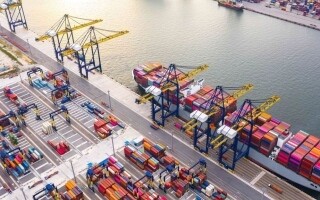
This initiative aims to integrate all stakeholders into a comprehensive ecosystem that includes farms, factories, supply chains, and retail, addressing challenges with a 'win-win' mindset to ensure the benefit of all parties and support the country's competitiveness. The country's ports play a major role in cementing the UAE's leadership and enhancing its logistical standing in the regional and global food sector. For example, Jebel Ali Port handles about 73% of the UAE's food and beverage trade by value, connecting companies with more than 150 ports worldwide, ensuring seamless and safe international food trade.
'Dubai Food Zone', whose technical and design details were recently unveiled by DP World, further strengthens Dubai's and the UAE's position in the world of food supply chains. It will be developed in several phases, with the first phase set to launch in 2027. The zone will provide an integrated ecosystem for the food sector, featuring advanced cold storage facilities, temperature-controlled warehouses, primary and secondary processing centers, digital operational solutions, as well as wholesale and retail facilities and a dedicated hall for premium foods to serve both business and consumer sectors.
Mohammed Naser, an expert at Halal Aprovel Global, stated that the UAE's geographical location is strategically important globally, as it links the Middle East, Asia, and Africa, making the country a convergence point. He explained that the UAE have become a 'small world' where nationalities, legislations, and trends, especially those related to the global and halal food systems, meet. He noted that what significantly distinguishes the country and enhances the efficiency and importance of its location is its integrated infrastructure. Ports, airports, and advanced road networks have positioned the UAE as a key node for global food distribution chains. He emphasized that the strength of infrastructure forms the foundation upon which supply chain efficiency is built, much like any production system needs its basic tools to function efficiently.
Meanwhile, Mohammed Badr Al Din, Director of Warehousing at Al Sharqi Logistics Services, highlighted that the UAE's geographical location, combined with its advancements in the logistics field, have made it one of the most important countries and sites for managing the vast quantities of goods flowing between world nations. He explained that the UAE's port system serves most of the world's ports and plays a pivotal role in connecting trade flows between Asia, Europe, and Africa, supported by a developed network of roads and airports spread across all emirates. He also mentioned that the UAE has started operating a cargo rail network, which will be extended for passenger transport in the future, enhancing delivery efficiency and boosting the competitiveness of the national logistics sector. Regarding global supply chain challenges, Badr Al Din pointed to issues including insurance, price volatility, and stability, confirming that the UAE provides a safe and sound environment for cargo transit through its various ports, adhering to the highest health and environmental standards to ensure protection from various risks.