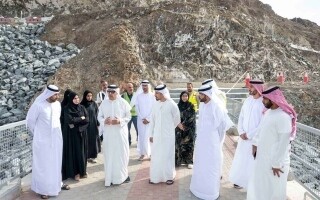
The Ministry of Energy and Infrastructure oversees the implementation of vital federal projects in the roads, buildings, and services sectors. These include the development of Emirates Street, the construction of a court and public prosecution in Dibba Fujairah, and a public health building for the Dibba Al-Hisn Health Center, alongside projects for dams and water channels in the Eastern Region as part of an integrated system that enhances efficiency and sustainability. These projects are being implemented within the framework of developing federal infrastructure, enhancing its readiness to support economic and population growth, and improving the quality of life in line with the country's vision and the directives of its leadership. A senior official inspected the progress of work on several federal projects to ensure adherence to approved schedules and to accelerate implementation in accordance with the highest standards. One of the key projects supervised by the ministry is the development and upgrading of Emirates Street, one of the most prominent projects within the federal road network. The street plays a pivotal role in supporting traffic flow, enhancing mobility, and improving the efficiency of goods and services transportation. The project includes the development of Intersection No. 7 by constructing six directional bridges with a total length of 12.6 km and a capacity of up to 13,200 vehicles per hour, in addition to constructing collector roads spanning 3.4 km. The project's cost is estimated at 750 million dirhams, with execution commencing in September 2025 over a two-year period. It aims to reduce travel times by up to 45% and mitigate traffic congestion. Furthermore, the project involves expanding Emirates Street from three to five lanes in each direction over a 25 km stretch, increasing the road's capacity to approximately 9,000 vehicles per hour, a 65% increase. The project for constructing a court and public prosecution in Dibba Fujairah is part of developing judicial infrastructure and enhancing service quality in line with best practices and approved standards. It embodies the state's approach to developing modern, sustainable government buildings by applying smart systems that contribute to energy and water efficiency, reduce environmental impact, and improve operational efficiency, thereby enhancing service quality and the user experience. The project for the public health building of the Dibba Al-Hisn Health Center is also part of efforts to support and develop federal healthcare facilities, enhancing their readiness to provide comprehensive health services that meet community needs. The project relies on smart solutions and modern digital technologies to improve the indoor environment, increase energy and water efficiency, and reduce carbon emissions, reflecting the national direction towards sustainable, high-efficiency healthcare facilities. The projects also include several dams and water channels in the Eastern Region, constructed using local materials, which has helped reduce the environmental impact and lower the carbon footprint, increasing the efficiency of local resource use by about 70%. These projects adopt natural and sustainable drainage solutions that reduce operational and maintenance requirements and support the long-term sustainability of water resources. The official affirmed on this occasion that the infrastructure projects being implemented by the ministry represent a fundamental pillar in supporting the country's competitiveness and ensuring the readiness of federal infrastructure for future requirements. He noted that the ministry operates according to a comprehensive vision based on proactive planning and adherence to the highest international standards in design and execution. He stated that infrastructure projects are implemented in line with a comprehensive vision based on proactive planning and the adoption of the world's best specifications and standards in design and execution, ensuring their readiness to keep pace with urban expansion and population growth, and achieving a sustainable developmental impact that contributes to improving the quality of life and supporting the national economy.