The United Arab Emirates emphasized the importance of international cooperation in protecting cultural heritage, noting the partnership between the UAE and UNESCO in the 'Revive the Spirit of Mosul' initiative as a model for post-conflict cooperation. The state expressed its welcome for cooperation with all member states and partners to support efforts to restore and revive cultural heritage at risk worldwide.
During the conference, the UAE's growing role in the fields of culture, heritage, and education was highlighted. The country's election as Vice-President of the UNESCO General Conference at its 43rd session reflects its status as a trusted partner in cultural diplomacy and international development efforts, as well as its current role in chairing the Arab Group at UNESCO.
Coinciding with the conference, UNESCO celebrated the 50th anniversary of the passing of the Emirati poet Ahmed bin Salem, one of the most prominent classical and vernacular poets, and a major literary and historical figure in the UAE, and the 50th anniversary of the founding of the United Arab Emirates University (1976), the first higher education institution in the country, in recognition of their prominent role in promoting cultural and educational values aligned with the organization's principles.
This tribute honors the literary and intellectual contributions of Ahmed bin Salem, which played a pivotal role in shaping the region's poetic and cultural landscape in the first half of the 20th century. His work reflects the identity of Emirati society, its values, and its authentic human experience. Meanwhile, the celebration of UAE University acknowledges its leading role in the journey of higher education in the country and the region. Since its establishment in 1976, the university has prepared national cadres in various fields, contributing to the knowledge economy and sustainable development in the nation.
Today, the university stands as a model of cultural diversity and academic excellence, hosting students and faculty from around the world in an environment that fosters coexistence and cultural openness.
These achievements underscore the UAE's growing presence on the global cultural stage and its enduring commitment to honoring and preserving its intellectual and creative heritage in line with UNESCO's mission.
It is worth noting that in 2025, UNESCO commemorated the centenary of the birth of the great Emirati poet Sultan bin Ali Al Owais, recognizing his poetic legacy and rich cultural contributions.
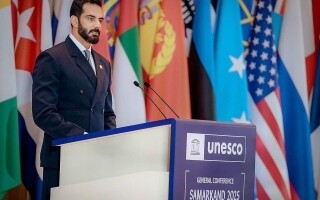
The United Arab Emirates was elected as Vice-President of the General Conference of the United Nations Educational, Scientific and Cultural Organization (UNESCO) for its 43rd session, currently held in the city of Samarkand, Republic of Uzbekistan, and running until November 13, with the participation of representatives from 194 member states.
The official UAE delegation to the conference was headed by Sheikh Salem bin Khalid Al Qasimi, Minister of Culture and Chairman of the National Committee for Education, Culture, and Science. The delegation also included Ali Al Hajji Al Ali, the UAE's Permanent Delegate to UNESCO, and Itisam Zaabi, the Acting Secretary-General of the Committee, alongside representatives from several national entities concerned with culture, education, and the environment.
Concurrently with the conference, UNESCO announced the inclusion of the late Emirati poet Ahmed bin Salem and the United Arab Emirates University in its list of honorees for its 2026–2027 program, which celebrates individuals and events with a significant impact on culture, education, science, and peace worldwide.
Sheikh Salem bin Khalid Al Qasimi affirmed that the UAE will continue its commitment to supporting UNESCO's mission and making a tangible impact in the areas of knowledge, cultural understanding, and scientific progress, which are fundamental pillars for building a better future. In this context, he announced the UAE's candidacy for a seat on the UNESCO Executive Board for the period 2027–2031.
In his speech during the conference, he said: 'We, in the United Arab Emirates, believe that building peace passes through education, science, and culture. They are the cornerstones on which UNESCO's mission is built and form the basis of the international cooperation our world needs more than ever. After 2030, our joint efforts must be more flexible and forward-looking to address new challenges and seize future opportunities.'