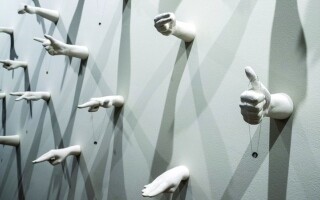
At the intersection of art and humanity, the 'Nabra' project presents a artistic vision that transforms plaster and gold into artistic mediums that whisper in the language of sign language, aiming to highlight the importance of integrating the deaf and mute into the fabric of society.
Through sculptures that embody the forms of hands crafted from the warmth of white plaster, the letters of sign language come to life, while necklaces adorned with diamond particles dangle from these hands, adding an enchanting sparkle. Thus, the artistic project offers a sensory approach that captures the essence of communication, turning the echo of sounds into a feeling and meaning pulsating with beauty, in a call to discover the language of hands and what it holds in sounds that words do not speak.
Nora Mohammed Al-Jameel from 'Masar Collective', which launched the project during the 11th edition of 'Dubai Design Week', spoke to 'Al-Ittihad', saying: 'We launched the initiative and the project as part of Design Week, seeking to integrate design with a social dimension, and to offer a comprehensive experience that encompasses sensory, visual, and human aspects.'
She added: 'The Nabra project consists of a collection of necklaces designed in collaboration with the jewelry company Eon. These are exclusive necklaces that celebrate sign language. We also worked on a series of sculptures that present the letters of the language in a distinctive compositional style.' Al-Jameel pointed out that the initiative's concept is based on the principle of cooperation, explaining that the choice of Dubai Design Week as a starting point was to embody this principle by inviting creators to meet and exchange experiences. She also mentioned the collaboration with 'Bayt Al-Tin' for the sculptures, as well as the daily presence of representatives from the deaf and mute community at the exhibition to foster lively interaction with visitors, teaching them the basics of sign language in an experience that enhances social integration.
In turn, Emirati jewelry designer Rawaia Ahmed from Eon spoke about her collection, saying: 'In our designs, we focus on the underlying meaning of each piece. All our jewelry expresses people and their identities. These necklaces in particular carry a deep human dimension, which encouraged us to collaborate on this project.'
She added: 'Our designs always carry an imprint of tranquility and simplicity to suit daily life. Therefore, when we decided to embody sign language, we ensured that this imprint remained. We relied on finger movements within small circles surrounded by diamond particles, while the bases were made from precious stones like lapis lazuli and mother-of-pearl.' She explained that the necklaces embody the symbols of 10 letters of the Arabic language, noting that contemporary jewelry usually acquires multiple meanings, but what distinguishes this collection is its human dimension, making it closer to people. She also stated that preparing the designs took five months, during which more than six experiments were conducted to achieve the final form and size of the displayed pieces.
As for Emirati artist Madar Al-Suwaidi from 'Bayt Al-Tin', she spoke about her role in designing the sculptures, saying: 'We usually work with clay, but for this project, we chose plaster to highlight sign language. The designs carried many emotions that affirm that communication is not limited to speech, but can be expressed through hands.'
Al-Suwaidi added that she ensured the sign language letters were clear and precise to avoid misreading, emphasizing that this language is a reminder that all people are capable of communicating and expressing themselves in diverse ways that should be accepted and respected. She added that designing the hands in various sizes and dimensions gave the artistic composition visual depth and helped make the language clearer. She pointed out that art is, in its essence, a universal language capable of expressing human issues, carrying within it openness, acceptance, love, and communication, and concluded by saying that the most prominent feature of the project is that it is the fruit of cooperation among three Emirati women brought together by a noble social cause.
'Community Year'
Nora Al-Jameel considers the 'Nabra' project to be social in its primary dimension, aiming to shed light on people of determination in general, and the deaf and mute community in particular, striving to integrate them into society. She clarified that the choice of this category aligns with the declaration of 2025 as the 'Year of Community' and the celebration of the Golden Jubilee of the Arab Deaf Federation.
She added that launching the project at a major artistic event aims to find solutions to enhance communication among different segments of society and achieve role complementarity.
Rawaia Ahmed: • We relied on finger movements within small circles surrounded by diamond particles, while the bases were made from precious stones like lapis lazuli and mother-of-pearl.
Madar Al-Suwaidi: • The designs carried many emotions that affirm that communication is not limited to speech, but can be expressed through hands.