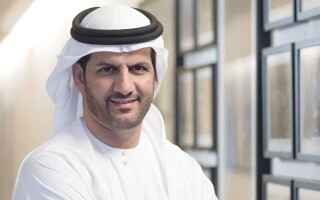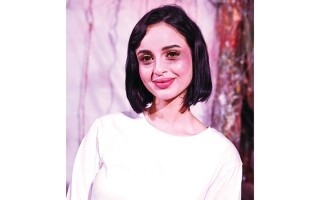
On the fifth day of the Dubai Youth Theatre Festival, held under the umbrella of the Dubai Performing Arts Festival, the play 'The Knower Does Not Know' premiered. The performance, which relies on bodily gestures, took to the stage. The director began with a warm introduction amidst a surreal scenography, leading the audience to a stark truth loaded with questions about real faces and falling masks. The work intersects the claim of knowledge with the fragility of consciousness, and the stage stands witness to a generation caught between its true image and its reflection on social media platforms. The show is akin to an internal journey that shakes off the dust from masks that have become so integral to faces they are now part of them. In the first scene, young men enter a strange place resembling a cave, containing incomprehensible objects. This peculiarity prompts one of them to dive into capturing photos to post on social media, and the group begins to change their clothes to embark on this journey within the space. The play reveals a scathing critique of the superficiality of virtual presence and the gap between appearance and existence, as scenes unfold like mirrors shattering one after another. The young men don clothes that do not suit them and speak in ways that are also uncharacteristic, but the false glamour of the personas they wear entices them to remain within those assumed identities. As is his custom, author Abdullah Al-Muhairi weaves the threads of the work through a love story, which becomes the key that drives the events and characters. Through dramatic skill, we witness in this work a love story that seems like a test of truthfulness; it becomes the measure against which masks fall, revealing faces long imprisoned by artifice and boasting. Only love, which cannot tolerate masks or reside in falsehood, can achieve this. The scenography, composed of columns and torn fabrics, gave the stage much strangeness, but it was not merely a visual frame; it transformed into a dramatic partner in the events. The characters move within it as if moving through layers of consciousness. Furthermore, director Mohammed Al-Suwaidi gave it an aesthetic dimension by adding a screen that transmitted what was happening behind the curtains, in addition to the fractured lights that suggested the events were in a space between reality and its reflection, between the self and its image. All the elements created on stage give the viewer a feeling of being in an unfamiliar place where time is indeterminate; its aim is to document a reality besieged by digital masks. The play brought together seven actors, who all stood on the stage in many scenes, and succeeded in conveying their high energy of presence to the audience, despite the challenge it presented, especially as they were portraying the inner chaos of characters and translating the intensifying struggle with the self. The rhythm in which the work proceeded was not without comedy, which entered the events to break the psychological severity offered by the text. The final scene came loaded with a powerful cry: 'The real faces are only seen when the mirror breaks.' This cry scatters the illusory reflections for the human to be revealed from within, and the dramatic rhetoric reaches its peak. The shattering of the mirror becomes a symbolic event for the recovery of the self, or a late admission that the knowledge claimed by some is nothing but a thin crust hiding complex ignorance. The work constituted a reading of a reality thick with masks and a society chasing its own image, affirming that the truth is not what we see on screens, but when we dare to look at ourselves without falsification. Director Mohammed Al-Suwaidi told 'Al-Ittihad': 'This is my first directing experience at the Dubai Youth Theatre Festival, and I sought, through the directorial vision, to shed light on the masks that people wear simply because they hold their phones to take pictures to post on social media platforms.' He pointed out that the setting carries a strangeness, which is why the scenography resembled a cave or a hut, and it carried the clothes through which humans transform and wear personas that do not suit them, yet they cling to them even though they do not suit them. He noted that dealing with a large number of actors on stage presented significant challenges, but they mastered their performance and helped him present his vision in the best possible way. Yemeni actress Burayya Khaled spoke about her role, saying: 'This role carried many challenges, especially in terms of performance and movement, but it was different, and I was able to highlight my artistic capabilities through it.' She noted that the Dubai Youth Theatre Festival is a distinctive opportunity to develop skills; it is like a workshop for training and improving performance skills. Author Abdullah Al-Muhairi told 'Al-Ittihad' that he drew inspiration for the story from a global text by playwright Molière, explaining that after writing the play, the text underwent a rewrite with actor Shehab Sbeit, who played the role of 'The Knower,' noting that the text went through many stages and took different forms until it was presented on stage. He stressed that when an author draws inspiration from works written previously, they do so from the outset of writing any work, as they initially search for similar ideas, and it happens that a known dramatic text attracts them, and they rewrite it. He also emphasized that in this era, we see many people being placed in categories that do not reflect their true selves, pointing out that he always seeks to find dramatic lines that are close to society so that the messages presented to the audience are not too harsh.