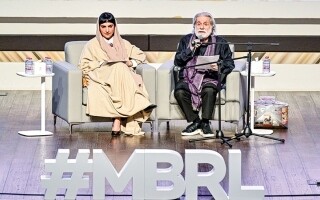
Is there a place today for poetry, music, and language in this terrifying scene of destruction, ruins, and debris? After tens of thousands of martyrs, the wounded, and refugees, who can write a poem or sing while living with death? This is salvation. With these words, artist Marcel Khalifa began a cultural dialogue session recently held at the Mohammed bin Rashid Library in Dubai under the title 'Melodies That Pulse with Arabic,' in celebration of World Arabic Language Day, which falls on December 18.
During the session, which was not without singing, as the Lebanese artist played on the oud and performed some of his famous works, Marcel stated that 'language and poetry are the salvation from a bad reality and the impotence of truth. Every song and poem written now is a sun that brings us back to life and saves us; it is a victory over death.' He affirmed that his participation in the session stems from hope in this time, as well as a desire to support the people of Palestine and Lebanon.
At the beginning of the dialogue, moderated by Emirati novelist Rima Al-Kamali, Marcel delivered a speech in which he spoke about the Arabic language and its importance to its people, and how they expressed diverse images and sang about the beloved through it. He stressed the importance of poetry in his career, citing many poems he had sung, including 'I am Joseph, O my father,' 'Andalusia of Love,' and 'The Mural,' which he announced he was close to finishing.
Marcel revealed that the poem closest to his heart is 'I long for my mother's bread.' He explained that this poem means a lot to him because his mother was his first supporter, the reason he entered music and art, unlike his father, who held a classical view and wanted him to become a lawyer or a doctor. His mother noticed his musical talent when he was tapping on the table and kitchen utensils, and insisted on buying him a musical instrument. She taught him with a music teacher who recognized his talent and suggested enrolling him in a music institute. Marcel spoke with pain about his mother passing away at a young age, before she could hear the poem and song, which is why they are so dear to his heart.
As for the poem 'I walk with my head high' by poet Samih al-Qasim, he noted that he composed it in the Rast maqam due to its connection to a difficult period—the invasion of Beirut in the 1980s. He decided to present it in a different style than national anthems, which are composed like military marches, and thus it became similar to the muwashshah and hajaaj, transforming into an Arab anthem sung everywhere.
The relationship between Marcel Khalifa and the late poet Mahmoud Darwish formed the basis of the former's artistic journey. He recalled his relationship with Darwish, from the beginning of composing to his poems before meeting him, through their first meeting and Darwish's reprimand for composing his poems without his permission or consent, to the birth of their friendship, and finally to his last farewell in Amman.
Marcel announced that he had completed work on 'The Mural,' which consists of over 100 poetic pages and contains many worlds, including life and death. Musically, it includes an orchestra and a choir. When it is performed on stage, it will be a kind of performance art. He noted that the voice of Mahmoud Darwish was used, woven into the fabric of the work. He described 'The Mural' as a great work of a great poem, which took two years to create.
Regarding the connection between poetry and music, he believes that when a poem turns into a song, it becomes closer to people. The audience, through music, sings along to difficult songs. Moreover, music has benefited from the beauty of poetry and its rhythm, while poetry has benefited from music by getting closer to the audience.
Marcel touched upon the aesthetics of the Gulf's heritage in old hajaaj and said: 'There is a very important heritage in the Arab world, whether in the Mashreq or the Maghreb, in the Levant countries or even the Gulf. I listened to Gulf songs about pearl diving, especially those sung during the start of the journey, waiting, and return. There is a rich heritage that has not been worked on, and we can renew this essential memory in this place, and of course, stunning works of art will be produced.'
Marcel Khalifa played the oud and performed some of his famous works, including 'The Doves Fly,' asking the audience to sing along. He also presented a collection of other poems by Mahmoud Darwish, such as 'Rita and the Gun,' 'A Song on My Mind,' and 'I long for my mother's bread.' The songs he performed received a great response from the audience, who asked him to perform more famous songs still etched in memory and soul.
Human feeling... different
Marcel Khalifa said that he is not afraid of the impact of artificial intelligence in many fields, especially in music, pointing out that it is a work that requires talent, while artificial intelligence creates things based on data it possesses. He described it as a helpful tool for recording and techniques, but it cannot compose music and poetry that reaches the level of human creativity.
He added that human error is an essential and beautiful part of the artistic process. He recalled his love for linguistic errors since childhood, which pushed him to develop his language, confirming that machines and artificial intelligence cannot replace human feeling and vision in art.
Marcel Khalifa:
- 'I long for my mother's bread' is the poem closest to my heart, because my mother was my first supporter.
- Every song and poem written now is a sun that brings us back to life... it is a victory over death.