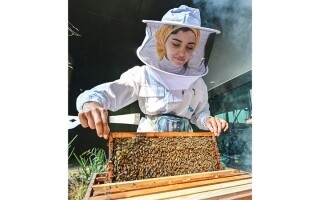
To a world that tastes of honey, in the company of the 'Bee Lady', 'Terra — Dubai Expo City' is opening new doors on the journey towards sustainability and environmental preservation. It has launched the first comprehensive training course in beekeeping for beginners, based on an educational experience that takes participants on an exploratory journey into how to care for bee colonies, the role of pollination, and the importance of biodiversity in urban environments. The course combines direct hands-on training, field trips, and interactive sessions designed to simplify scientific concepts and enhance the connection with nature. The program comes as part of Terra's evolving role as a living laboratory for sustainability and a community-sharing platform, coinciding with the launch of the Jane Goodall Garden for Pollinators and the '100 Hives' initiative, which aims to embed a culture of beekeeping in schools, parks, and community spaces, in support of Dubai's 2040 Urban Master Plan. The program is led by environmental scientist Dr. Mariam Hammal, known as the 'Bee Lady,' who yesterday gave an exclusive briefing to the media on the secrets of beekeeping, honey production, and tasting. Dr. Mariam told 'Al Ittihad': 'I designed this course for beginners to reconnect humans with pollinators as essential partners in the ecosystem. The course covers several topics related to beekeeping, including the human relationship with it, bee biology, the basic tools for beekeepers, and the diseases and pests that bees face and how to deal with and treat them, as well as extracting honey using sustainable methods.' She added that there are 20,000 species of bees in the world, but honey is produced from only seven of them, and of these seven, only one species is bred and used inside hives. She explained that the course will allow for an understanding of the behavior of these creatures, the components of the hive, the role of the queen, worker, and drone, and the nature of managing a bee farm. She pointed out that the bees in Terra are of the Apis mellifera species, which has existed in the UAE and the Middle East since ancient times, but due to genetic pollution, local strains were lost. She confirmed that the local strain found in Terra is the one that was discovered during the construction of Dubai Expo and was subsequently adopted. She emphasized that the new program works to raise awareness about protecting local strains, in addition to other programs that work to spread the culture of beekeeping. Dr. Mariam explained that the challenges in beekeeping are numerous, including finding a suitable place to place the hives, especially given the dry nature of the UAE, as well as the importance of choosing the right time of year, as there are four seasons for beekeeping, with the best period extending from October to April. As for the essential equipment to enter this world, she considers it traditional, stressing the importance of smoking for extracting honey, as it has an effect that makes the bees feel dizzy, allowing for safe handling. She noted that one of the most prominent pests that affect bees is the Varroa mite, which cannot be seen with the naked eye and affects the bees, and thus the hive, as it impacts the amount of honey they collect. There are two beehives in Terra for awareness-raising and spreading bee culture. Regarding the types of honey produced in the UAE, Dr. Mariam said there are four, with variations in color, smell, and taste depending on the flowers from which the bees collect nectar. She mentioned the Samr, Sidr, Ghaf, and Talh flowers. Samr is the richest honey in iron, Sidr has a golden color and a velvety taste, Ghaf honey crystallizes, but this does not reflect its quality, but rather indicates that its glucose content exceeds its fructose content. Dr. Mariam concluded that this course will increase curiosity about the world of bees, especially among young people who approach the hives and learn about their behavior up close, which opens up an appetite for knowledge about nature. Dr. Mariam Hammal confirmed that there is no way to discover original honey better than placing it under a microscope in laboratories to reveal its acidity level, moisture content, and the type of sugars present, whether glucose, fructose, or sucrose, in addition to conducting a special test for pollen grains, as their residues remain in the honey and determine its type. Tasting also helps determine the type of honey. Dr. Mariam Hammal: 'The course was designed for beginners to reconnect humans with pollinators as essential partners in the ecosystem.' 'The program comes within the framework of Terra's evolving role as a living laboratory for sustainability.' 'There are 20,000 species of bees in the world.'