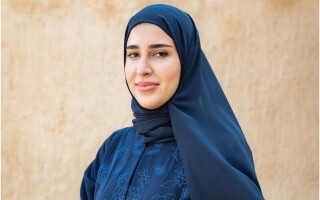
The 'House of Culinary Arts' initiative encourages chefs to think outside the box, praising the experience, especially as it attracts various nationalities and introduces them to Emirati cuisine.
Art, Benches, and Archives The artistic experience at the House of Culinary Arts is incomplete without a dedicated space for artworks. The house hosted an exhibition featuring a collection of paintings and installations that tell the story of flavors. Many artists participated, including Khoola Al-Raisi, who presented a digital work that frames the meal as a social and spatial context reflecting the evolution of Emirati family dining. Meanwhile, artist Aliya Al-Shamsi presented oil paintings that embody the evolution of food through a single dish that incorporates elements inspired by diverse crafts and cultures. In addition to paintings, the exhibition showcased a collection of benches and wooden pieces crafted at Saif Al-Qisi carpentry workshop, Dubai's oldest. The National Archive also provided an archival video highlighting the transformation of food-related culture, featuring footage dating back to the 1960s.
The 'House of Culinary Arts', organized as part of the Sikkat al-Sikka Arts and Design Festival in Dubai's historic Al Shindagha district, explores the evolution of Emirati cuisine as a living, adaptable cultural practice shaped over time by environment and mobility.
Twelve chefs are participating in the 'House of Culinary Arts', held under the theme 'With and Among Our Food' and running until the end of the Sikkat festival, which began the day before yesterday. Each chef will present food experiences and recipes that highlight changes in ingredients and cooking techniques, demonstrating how food remains a living expression of history, cultural exchange, and continuity.
Noura Al-Falahi, the curator of the House of Culinary Arts, told 'Al-Ittihad' about this experience: "We researched the evolution of Emirati cuisine over time, within natural environments including desert, mountain, and oasis, and what each contains in terms of food and ingredients. We also explored the theme of trade and cultural exchange and the changes they brought to flavors and dishes, as well as the modernity that has emerged among the younger generation, which blends Emirati cuisine with diverse flavors."
She added: "Participating chefs in the dinner clubs held daily during the Sikkat festival can choose a specific theme to work on, whether it's cultural exchange or diverse environments, and then create dishes for a special dinner. It is crucial to clarify the nature of Emirati cuisine."
Diverse Environments Al-Falahi explained that the research revealed differences across diverse environments. The desert environment featured many dishes, such as Harees, Lugaimat, Machboos, and Markouq. In contrast, the coastal environment highlighted fish and seafood dishes like grilled fish, fish Machboos, and Saloona. She noted that chefs were selected based on several criteria, with an emphasis on diversity between Emiratis and residents to present a range of flavors, while also allowing chefs to conduct research that highlights local cuisine.
The participating chefs are: Huda Al-Ghafli, Aliya Al-Ali, Khoola Al-Ghafli, Hatem Matar, Maitha Al-Ghafli, Surabhi Suri, Abdurrahman Luthah, Gabriela Chamorro, Mohammed Al-Hosani, Khaled Waleed, Asail Mohammed, and Abir Al-Louz.
Al-Falahi emphasized that the experience integrates food and art, with small circular tables inspired by 'suroor' (traditional trays for serving food) designed for the event. The dinner table was also made circular to create an intimate, family-like atmosphere. She mentioned that the design was handled by Sheikha Al-Taneiji, who ensured the center of the table had empty spaces planted with trees native to the Emirati environment, like the Ghaf tree, and plants from other regions as a symbol of cultural exchange.
She confirmed that the event attracted a wide audience last year, leading to a renovation of the house and an expansion of research, especially as the 2025 edition exclusively uses saffron.
Correcting Misconceptions On the opening day of the 'Sikkat' festival, Emirati chef Abdurrahman Luthah prepared the dishes, speaking about the experience he wanted to offer: "Emirati dishes are distinguished by their unique flavors, but many people do not know them well. Therefore, I focused on local ingredients and blended them with Japanese, Italian, and American flavors, creating five dishes for the dinner menu."
He added: "Through this menu, I aimed to correct some misconceptions about Emirati cuisine. For example, some people think Biryani is an Emirati dish, but it is not. So, I presented Machboos Risotto, which used a unique blend with Parmesan cheese. I also served Japanese-style fried rice with Emirati Jashid."
Luthah also noted that he added a 'Hassu Matar' shawarma sandwich to the menu—a sandwich beloved by Emiratis, named after Hassan Matar, who requested it with special ingredients at a cafe and it became very popular among citizens. He mentioned the ingredients are shawarma, tahini, garlic, mayonnaise, cheese, and potato, and he will serve it in a special and distinctive way.
He explained that in creating the dishes, he experimented with flavors and their harmony, choosing the most delicious. This is the first time he has relied on blending flavors, and he was amazed by the stunning results of merging Emirati dishes with global flavors. He noted that the primary Emirati dishes he relied on were Machboos and Jashid. He also served saffron and rose water lemonade, and the dessert was a dish of dates, cardamom, saffron with Oreos, cream cheese, and chocolate, featuring a variety of flavors.