In a single room, and through a short film of up to 19 minutes, Emirati director and writer Sultan bin Dafoon addresses the deep pain and void left by a mother's absence and death during childbirth. He sheds light on children who have lost their 'dear mother' and the emptiness in their hearts in his film 'Matar' (Rain), while also striving to present this group as a symbol of hope and continuity in life. The film was screened internationally and won numerous awards at international festivals before being shown in the UAE. The public had the chance to see it during its participation in the Sikka Arts and Design Festival, which recently concluded in Dubai, as well as at the Expo 2026 International Photography Festival in Sharjah. Sultan bin Dafoon revealed at the start of his interview with 'Emirates Today' that the film, which he wrote, directed, and produced, is a project that took a long time to write, as he spent nearly a year preparing for it. He described it as a very human film and wanted the dialogues to be poetic and indirect, adding: 'I also used artificial intelligence for the dialogues, asking it for more poetry in the monologues, which was a very unique experience. The film's cinematography presented some challenges, but the most beautiful challenge was that this film was shot in a single room. The filming was exhausting from a directorial standpoint because I sought to capture around 53 angles to avoid repetition and rely on camera movement diversity to produce the maximum number of dissimilar scenes.'
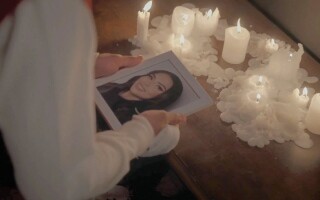
Persistence in Continuing. Regarding the 'Matar' film's cast, bin Dafoon pointed out that the film stars actor Jamal and the emerging actor Yousuf Al Balushi, who had participated in theater. He explained that 'Matar' embodies the pain and void that occupy the hearts of children whose mothers died during childbirth. It focuses on the story of a wheelchair-bound grandfather raising his grandson. The events escalate on a rainy night when the power goes out, and the grandson spends it with his grandfather by candlelight, prompting memories to drive the plot forward until the son discovers that his grandfather was the cause of his mother's death due to a mistake he made during her delivery. He noted that the film is Emirati, and the dialect used is Emirati, but the image presented is not tied to society, as it is presented outside the framework of the place. He clarified that the film was screened at more than 23 international festivals and will be shown at Expo 2026, competing with films screened at world festivals. He stated that as a director and writer, he carries the persistence to continue in this field, noting some platforms that support this creative industry, albeit with some conditions for providing support. He believes that Emirati youth need more support to be able to produce their own works in the film industry, especially since many films are produced with individual efforts, and some specialized production companies require high numbers for production. He praised the Al Ain Film Festival, which dedicates a category for the Emirati film, which constitutes support for workers in the film industry, especially since there are some other festivals that do not dedicate a category for the Emirati film.
Varied Experiences. Bin Dafoon has participated in many television and radio works, including 'Coffee Cartier,' describing his artistic experience as diverse between audio and visual works, in addition to the diversity of his production in acting and writing for theater. After testing many fields, he distanced himself from writing for adult theaters because he did not find himself in this experience, preferring to write for children's theater. He will also participate in acting in a series that will be aired during Ramadan, in addition to a radio series that will be broadcast on Sharjah Radio. He believes that radio series still retain their audience, especially from road users, despite the changing times and the public's increased passion for videos or following series on platforms that can be watched anytime. The film 'Matar' was screened at many festivals and was presented in more than 23 international screenings before its release in the UAE, including the International Film Festival in Ouled Taïma in Morocco, the Bangkok International Film Festival in Thailand, the Atlas International Film Festival, the Sudan International Film Festival, the Toronto International Film Festival in Canada, and many other festivals in various countries, including Lebanon, India, Syria, Kuwait, and Algeria. The film won several awards, including: Critics' Award at the Bangkok Film Festival, Best Drama Award at the Boden International Film Festival, Special Jury Award at the Digital Gateway Short Film Festival, Best Narrative Feature Award at the Sour International Film Festival in Lebanon, Best Cinematography Award at the Lebanon International Film Festival, and many more.