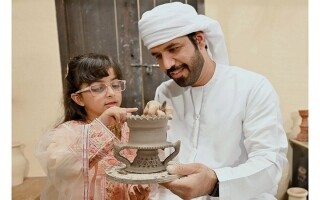
Traditional crafts are a major component of Emirati heritage, a testament to the skill of ancestors and their ability to utilize the few resources available in the environment to achieve the best benefit from them. Before work begins, the soil is sifted to purify it and remove impurities, after which it is pounded and mixed with water, then shaped. Saeed Al Shehi pointed out that the manufacturing of these pottery pieces is done using the same ancient method that the fathers were accustomed to using, in honor and appreciation of the heritage. However, with development, some changes have occurred, such as patterns inspired by historical sites and buildings, especially forts and castles, as well as a pattern inspired by Sadu weaving and other patterns related to the heritage. We rely on the clay of the UAE, especially the soil of Ras Al Khaimah, which is known as a center for pottery production in the UAE. The history of pottery in the UAE, according to archaeological evidence, dates back to the period of 'Umm an-Nar', i.e., the third millennium BC. Coinciding with the UAE's declaration of 2026 as the 'Year of the Family', we celebrate in this space the traditional crafts of the UAE and their owners who continue to work diligently and proudly to pass this heritage on to future generations, contributing to intergenerational communication and bringing members of society closer together. From the land of the UAE, ancestors were able to turn soil into simple tools they could use in their daily lives to help them prepare their food and drink, and other tasks. The history of pottery in the UAE, according to archaeological evidence, dates back to the 'Umm an-Nar' period, i.e., 3000 BC, as evidenced by graves discovered in Abu Dhabi and Al Ain, then it appeared in Ras Al Khaimah, and then in Sharjah and the rest of the country's emirates. Potter Saeed Al Shehi explained to 'Al Ittihad' that pottery making is one of the oldest traditional crafts inherited by the people of the UAE, and they still preserve it despite the development of life and the emergence of alternative tools made from other modern materials. He added: 'As the late Sheikh Zayed bin Sultan Al Nahyan, may God rest his soul, commanded us to preserve the past and adhere to customs, traditions, and the crafts of fathers and grandfathers, we adhere to this approach, so we strive to introduce new generations to traditional crafts and train them in them, with the aim of preserving this heritage and keeping it as part of the national identity of the state.' Al Shehi explained that pottery making includes many tools and shapes such as 'dalal', 'khurs', 'koz', 'yahla', 'madhan', and 'fingal', which were used in the past in homes and daily life, noting that traditional pottery relies on the clay of the UAE, especially the soil of the emirate of Ras Al Khaimah, which is known as the center of pottery production in the UAE.