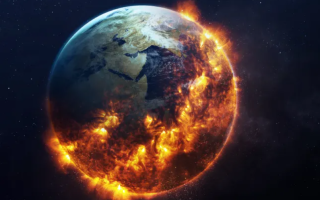
What would happen to our planet if the Sun suddenly disappeared? The Earth is completely dependent on the Sun. Without it, most plants that rely on photosynthesis would perish. Some might enter a short dormant state, but they would eventually disappear. Frost would cover most of the planet within a few days, ponds and lakes would gradually freeze, although the oceans might remain liquid for decades due to geothermal heat and active volcanoes. Over time, the Earth's temperature would approach that of the planet Pluto, but it would not reach absolute zero thanks to the residual radiation from the Big Bang that occurred about 13.8 billion years ago. Under these conditions, almost all human civilizations and surface life would collapse. Gravity keeps our planet in a perfect orbit within the so-called 'Goldilocks zone,' where it's not too hot and not too cold, allowing water to exist in its liquid state. The Sun is also the primary source of heat and light, supporting the water cycle and photosynthesis that feed most living organisms. Furthermore, its ultraviolet radiation is essential for producing vitamin D, which is important for bone and dental health. If the Sun were to suddenly disappear, we wouldn't realize it right away, as its light takes about 8 minutes and 20 seconds to reach Earth. During that period, everything would remain as is. However, after that time, a sudden and total darkness would fall, and the distinction between day and night would become impossible. The absence of the Sun would also disrupt the orbits of the planets, sending them adrift into space. But the greatest challenge for humanity would be on Earth itself, where life would become extremely difficult to sustain due to the lack of light and heat. Humanity could only survive in caves, benefiting from geothermal or nuclear energy and cultivating plants under artificial lighting. Some microscopic organisms, such as tardigrades and certain types of bacteria that rely on chemosynthesis instead of photosynthesis, would be able to survive in these harsh conditions. Fortunately for humanity, there is no reason to believe the Sun will suddenly disappear. While fungi might last for a while due to the availability of organic matter, they would suffer from extreme cold. The Earth's temperature would drop at a staggering rate of about 20 degrees Celsius every 24 hours. The Moonlight, which is reflected sunlight, would vanish, although the distant stars would remain visible. The Sun will continue to produce heat and light for another 5 billion years or so, but once its fuel runs out, it will turn into a 'red giant' that will swallow Mercury, Venus, and possibly Earth. The Sun has been Earth's constant companion since its formation about 4.6 billion years ago. But over time, it will die.