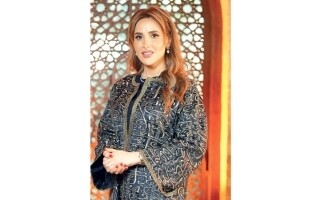
Traditional crafts are a main component of Emirati heritage, a testament to the skill of ancestors and their ability to make the best use of the limited resources available in their environment. The traditional headscarf, known as the "burqa," is characterized by its thin, double-sided fabric: one side is a lining dyed with indigo, and the other is polished to an elegant sheen. According to Um Ali Al Mansouri, the craft of making the burqa relies on simple tools: fabric, a needle, thread, scissors, a piece of wax or soap, and a polishing cloth used to buff the fabric. The process begins with cutting the fabric, then the inner side is rubbed with wax or soap to make it more flexible. Next comes the "kaf al burqa," or sewing it together, and attaching the "sif"—a wooden piece, often made of bamboo or local wood, that is fixed in the center of the burqa over the nose. In the final step, the "shabak" is attached. This is a cord used to secure the burqa on the head, and its color is traditionally red or silver, though gold has recently come into use. Women have always taken care of their burqas, maintaining their luster. Some would spray them with a little perfume or rub them with ghee to keep them shiny. They also stored them upside down, with the shiny side facing in. The burqa is made from a fabric called "shail," which is known for its softness, high quality, and two colors: a shiny yellow and an indigo blue. Um Ali Al Mansouri:• Interest in wearing the burqa has declined among young women, but the craft of making it is still alive.• Women traditionally wore yellow for special occasions and holidays, while indigo was for daily life. Coinciding with the UAE's announcement of 2026 as the "Year of the Family," we celebrate traditional Emirati crafts and their artisans in this space. They continue to work diligently and with pride to pass this heritage on to future generations, contributing to intergenerational communication and community cohesion. The traditional burqa represents a symbol of modesty and beauty in the heritage, and a distinctive part of the identity of the Emirati woman. Just as women inherited the wearing of the burqa from one generation to the next, they also inherited the craft of its creation, considered one of the traditional professions in society, known as "krad al burqa." Um Ali Al Mansouri stated that the burqa is an important part of the traditional Emirati woman's attire, a tool for modesty and face protection. She noted that girls used to start wearing it around the age of 16. She added that the burqa has become smaller in size for young women today, while mothers still hold on to wearing the traditional, larger-sized burqa. She pointed out that while interest in wearing the burqa has waned among young women, the craft of its production is still preserved to maintain this heritage and introduce it to new generations. She added that the burqa is made from a fabric called "shail," which was historically imported from India. It is distinguished by its softness, high quality, and its two colors: a shiny yellow and an indigo blue, where women used to wear yellow for celebrations and holidays, while indigo was for daily life.